日本語(English follows below)
10社読んで見えてきた。「企業は、人はどうすれば変わると考えているのか」
第二層観察プロジェクトで、日本企業の有価証券報告書を読み始めて10社。
これまで私は、各社について、
「どんな制度があるのか」
「女性管理職比率は何%か」
「どんな人材育成をしているのか」
を見てきました。
でも10社を並べてみると、もう一段奥に、違いがあるように見えてきました。
企業によって、「人はどうすれば変わるのか」という考え方が違う。
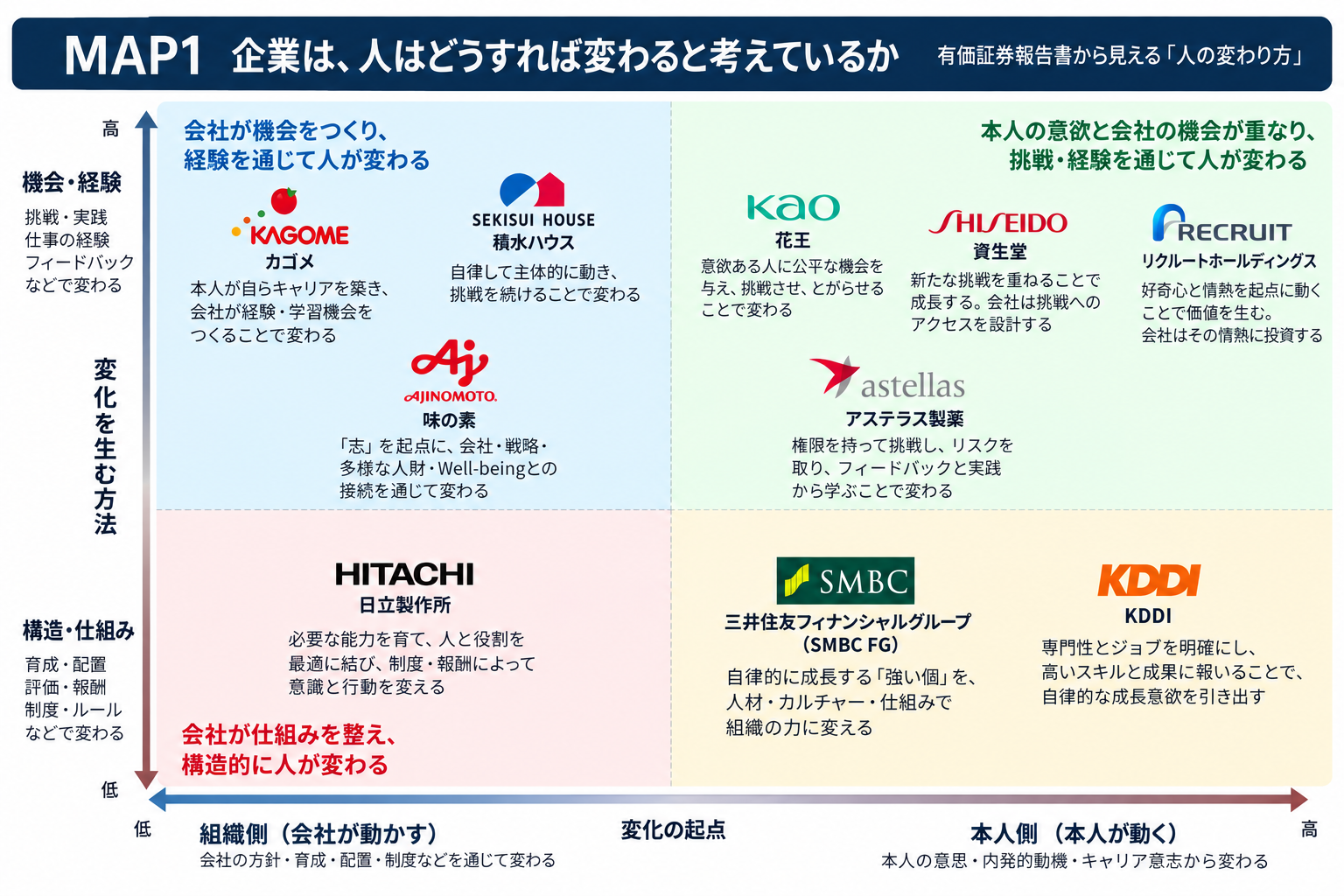
そこで、最初の10社を2つの軸で置いてみました。
横軸は、変化の起点。
左に行くほど「組織側が動かす」。
右に行くほど「本人が動く」。
縦軸は、変化を生む方法。
上に行くほど「機会・経験によって変わる」。
下に行くほど「仕組み・構造によって変わる」。
すると、同じ「人的資本経営」という言葉の下にある違いが見えてきました。
カゴメは、
本人が自らキャリアを築き、会社が経験・学習機会をつくることで、人は変わる。
積水ハウスは、
自律して主体的に動き、挑戦を続けることで、人は変わる。
日立製作所は、
必要な能力を育て、人と役割を最適に結び、制度・報酬によって意識と行動を変える。
味の素は、
「志」を起点に、会社・戦略・多様な人財・Well-beingとの接続を通じて挑戦を生む。
花王は、
意欲ある人に公平な機会を与え、挑戦させ、とがらせることで、人は変わる。
資生堂は、
新たな挑戦を重ねることで成長する。会社は挑戦へのアクセスを設計する。
アステラス製薬は、
権限を持って挑戦し、リスクを取り、フィードバックと実践から学ぶことで、人は変わる。
KDDIは、
専門性とジョブを明確にし、高いスキルと成果に報いることで、自律的な成長意欲を引き出す。
リクルートHDは、
好奇心と情熱を起点に動くことで価値を生む。会社はその情熱に投資する。
SMFGは、
自律的に成長する「強い個」を、人材・カルチャー・仕組みで組織の力に変える。
もちろん、企業自身がこのように宣言しているわけではありません。
私が有価証券報告書に記載された制度、人材育成、配置、マネジメント、ガバナンスを横に並べたときに見えてきた、現時点での「観察」です。
だから、この地図は企業の優劣を示すものでもありません。
むしろ興味深いのは、同じ目的に向かっていても、人が変わるために企業が触っている場所が違うことです。
・ある会社は、本人の自律を起点にする。
・ある会社は、挑戦や経験を変化の契機にする。
・ある会社は、専門性や役割を明確にする。
・ある会社は、人と役割を結び直す。
・ある会社は、制度や報酬まで使って行動を変える。
制度を一つずつ見ているだけでは、この違いはあまり見えません。
10社を横に並べて、初めて見えてきました。
これはまだ、10社時点の仮説です。
次の10社を加えたとき、この地図はそのまま成立するのか。
新しい「人の変わり方」が現れるのか。
今置いた企業の位置が動くのか。
20社、30社……と増やしながら観察していきます。
最終的には100社。
日本企業が「人はどうすれば変わる」と考えているのか。
有価証券報告書だけを材料に、その第二層を地図にしてみたいと思います。
※本マップは各社の有価証券報告書に記載された取り組み・方針をもとにした観察であり、企業の優劣を評価するものではありません。
After Reading 10 Companies: How Do Companies Think People Change?
As human capital management gains increasing attention, how are companies actually designing their organizational environments?
In this series, I observe what I call Layer 2 (the organizational environment) by reading only the officially filed Annual Securities Reports of Japanese companies.
I have now completed my first 10 companies.
Until now, I have looked at questions such as:
- What systems and programs does each company have?
- What percentage of managers are women?
- How does each company develop its people?
But when I placed the first 10 companies side by side, another difference began to emerge.
Companies seem to have different underlying assumptions about how people change.
So I mapped the first 10 companies along two dimensions.
Where does change originate?
Organization-led ←→ Individual-led
At one end, the organization actively designs and drives change.
At the other, the individual is expected to initiate action.
How does change happen?
Structures and systems ←→ Opportunities and experiences
At one end, change is created through structures such as roles, systems, expertise, placement, and rewards.
At the other, change happens through opportunities, challenges, and experience.
Looking through these two lenses reveals differences that are difficult to see when examining individual HR programs alone.
For example:
Kagome
People change by building their own careers, while the company creates opportunities for experience and learning.
Sekisui House
People change by acting autonomously, taking initiative, and continuing to challenge themselves.
Hitachi
People change when the company develops required capabilities, connects people with the right roles, and uses systems and rewards to influence behavior and mindset.
Ajinomoto
Change begins with individual purpose (“志”) and emerges by connecting people with the company, strategy, diverse talent, and well-being in ways that generate challenge.
Kao
People change when motivated individuals are given fair opportunities to take on challenges and sharpen their strengths.
Shiseido
People grow through repeated new challenges, while the company designs access to those opportunities.
Astellas Pharma
People change by being empowered to take on challenges, take smart risks, and learn through feedback and real experience.
KDDI
People change when expertise and jobs are clearly defined, and higher skills and performance are rewarded in ways that encourage autonomous growth.
Recruit Holdings
People create value by acting on their own curiosity and passion. The company, in turn, invests in that passion.
SMFG
People develop into strong, autonomous individuals, while talent, culture, and organizational mechanisms connect that individual strength to organizational performance.
Of course, these companies do not explicitly state, “This is how we believe people change.”
These are observations, derived from comparing what their Annual Securities Reports disclose about human resource development, career development, placement, management, organizational systems, and governance.
This map is therefore not a ranking of companies.
What interests me is something different:
Even when companies are pursuing similar goals under the broad banner of human capital management, they intervene in different places to create change.
・Some place greater emphasis on individual autonomy.
・Some rely on challenge and experience.
・Some clarify expertise and roles.
・Some connect people with roles more deliberately.
・And some use organizational systems and rewards to influence behavior itself.
These differences are difficult to see when looking at individual programs one by one.
They became visible only when the companies were placed side by side.
This is still only a hypothesis based on the first 10 companies.
What will happen when I add the next 10?
Will the same map still hold?
Will new ways of thinking about human change emerge?
Will the positions of the companies already on the map move?
I will continue observing this as the sample grows to 20, 30, and eventually 100 companies.
My aim is to map how Japanese companies appear to think about a fundamental question:
How do people change?
And to do so using only what companies themselves disclose in their officially filed Annual Securities Reports.
This map is an observation based on initiatives and policies disclosed in each company’s Annual Securities Report. It is not intended to evaluate or rank the companies.