日本語(English follows below)
女性活躍推進の現在地は、企業によってこんなに違う
― 有価証券報告書10社を並べて見えてきたこと
人的資本経営への関心が高まる中、企業は実際にどのような「組織環境」を設計しているのでしょうか。
このシリーズでは、日本企業の有価証券報告書だけを読みながら、私が**第二層(組織環境)**と呼んでいるものを観察しています。
今回は、最初の10社について、女性活躍推進だけを取り出して並べてみました。
1社ずつ読んでいると、それぞれの企業にさまざまな施策があります。
・女性向け研修
・女性管理職比率の目標
・メンタリング
・DE&I
・サクセッション
・経営KPI
・ガバナンスや役員報酬との接続
しかし10社を横に並べると、施策の「数」よりも、もっと大きな違いが見えてきました。
それは、
企業は、女性活躍を経営のどこに位置づけ、どこまで女性に直接介入しようとしているのか。
という違いです。
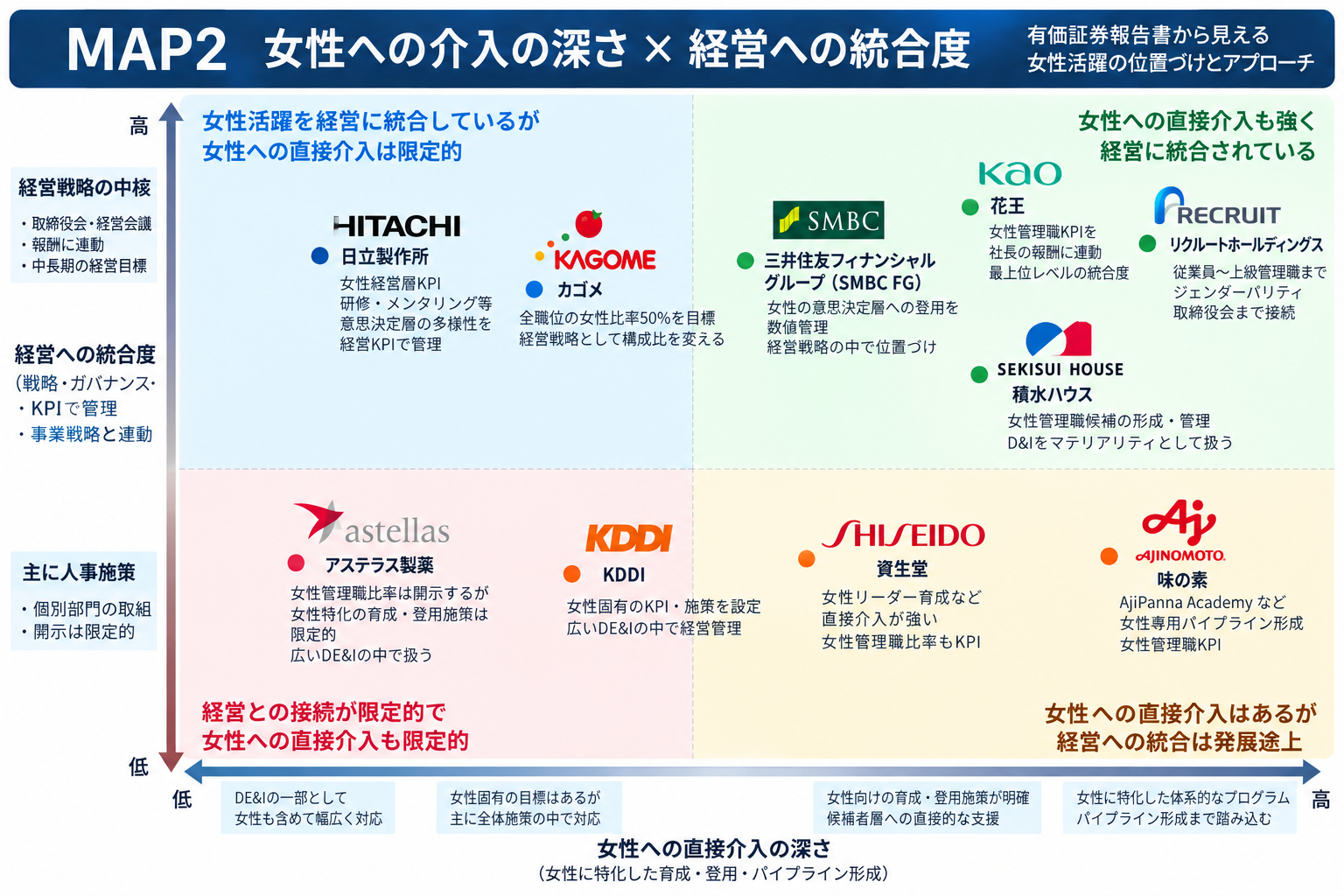
そこで、最初の10社を2つの軸でマッピングしました。
横軸:女性への直接介入の深さ
属性横断のDE&I・公平性 ←→ 女性パイプラインへの直接介入
縦軸:経営への統合度
人事・DE&I施策としての運用 → 経営戦略・ガバナンス・報酬まで統合
これは、企業の優劣を示すランキングではありません。
女性活躍を、どのような構造で実現しようとしているのかを見る地図です。
「女性への直接介入」と「経営への統合」は別々に動く
10社を並べて最も興味深かったのは、
女性への直接介入の深さと、経営への統合度は、必ずしも一緒には動かない
ということでした。
女性専用の育成プログラムが充実していても、それが必ずしも経営の評価システムまで統合されているとは限りません。
逆に、女性専用施策を前面に出していなくても、意思決定層の多様性そのものを経営課題として管理している企業があります。
つまり、
「女性に何をするか」と「女性活躍を経営のどこに置くか」は別の問題です。
味の素・資生堂:女性本人やパイプラインへの直接介入
味の素には、AjiPanna Academyがあります。
女性管理職比率という最終結果だけを見るのではなく、その手前にいる女性人材を育成し、パイプラインを形成しようとしています。
資生堂でも、女性リーダー育成など、女性への直接的な介入が見られます。
女性管理職比率も人的資本の成果指標として管理されています。
両社とも、女性への直接介入が比較的明確です。
一方、有価証券報告書から確認できる範囲では、女性KPIそのものが役員報酬まで直接接続しているとは確認できませんでした。
ここに、「直接介入」と「経営統合」を分けて見る意味があります。
花王:女性活躍を経営の評価システムまでつなぐ
花王では、女性管理職比率をKPIとして管理するだけでなく、その指標がKLPの目標達成指標の一つとなり、社長の長期インセンティブ報酬にも組み込まれています。
さらに、ESG委員会や取締役会によるモニタリングとも接続しています。
つまり、
女性への介入だけではなく、その結果を経営の評価システムまでつなげている。
今回の10社の中でも、「経営への統合」という縦軸で特徴が明確に表れました。
リクルートHD:組織階層全体のジェンダー構成を変える
リクルートHDは、従業員、管理職、上級管理職までジェンダーパリティを目標としています。
さらに、取締役会についてもジェンダーパリティを目指しています。
管理職候補層を広げるため、要件を明確にし、候補者を増やし、育成する仕組みもあります。
つまり、
女性管理職だけを増やすのではなく、組織の入口から意思決定層、取締役会まで、階層全体のジェンダー構成を変えようとしている。
という設計です。
積水ハウス:管理職になる前の「候補者層」に介入する
積水ハウスで特徴的なのは、管理職になる前の層です。
次期管理職候補となるP4・P5層を把握し、女性の候補者層そのものを形成しています。
つまり、
「女性管理職が少ない」という結果ではなく、その手前に十分な候補者がいるかを見る。
管理職比率という「出口」だけではなく、その前段階のパイプラインに介入する設計です。
日立製作所:意思決定層の多様性を経営KPIとして管理する
日立製作所には、女性向けキャリア研修、メンタリング、女性リーダー育成などがあります。
一方、より大きな人材戦略では、グローバルタレントマネジメントの中で多様性を扱っています。
さらに、女性の経営層比率を人的資本KPIとして管理しています。
女性専用のパイプラインを全面的に設計するというより、
「誰が意思決定層にいるのか」を経営課題として管理する。
という特徴が見えます。
KDDI:女性活躍を、より広いDE&Iへ統合する
KDDIにも、女性に関するKPIや施策があります。
しかし有価証券報告書全体を見ると、女性だけを独立したテーマとして扱うというより、障がい者、LGBTQ+なども含めた、より広いDE&Iの枠組みの中に位置づける方向が見えます。
つまり、
女性という一つの属性への介入から、多様な人が活躍できる組織環境そのものへ。
女性活躍を、より大きな組織設計の中へ統合していると見ることができます。
SMFG:意思決定層の構成を変える
SMFGは、女性専用育成プログラムを中心に見ると、味の素や資生堂とは異なります。
特徴的なのは、女性の意思決定層への登用を数値で管理していることです。
つまり、
女性本人への育成施策だけではなく、「意思決定する人たちの構成をどう変えるか」を見る。
女性活躍を、組織の意思決定構造の問題として扱う方向が見えます。
アステラス製薬:女性専用パイプラインへの介入は相対的に小さい
アステラス製薬では、女性管理職相当比率などを開示しています。
一方、人的資本戦略全体では、女性だけを対象とした育成・登用パイプラインは、それほど前面には出てきません。
むしろ、
ジェンダーを含む多様性を、より広い人材戦略の中で扱う。
という設計に近く見えます。
女性KPIがあることと、女性専用パイプラインへ直接介入することは、同じではありません。
カゴメ:女性50%という長期目標を、大きな人材戦略の中に置く
カゴメには、2040年頃までに「社員から役員まで各職位の女性比率を50%」とする長期ビジョンがあります。
一方、人材戦略全体を見ると、女性だけへの直接介入を中心に据えるというより、
人的資本 → DE&I → 多様な人材が活躍できる環境
という大きな設計の中に女性活躍を置いています。
女性活躍を、より大きな人材戦略の一部として管理しているように見えます。
10社を並べて、初めて見えたこと
「女性活躍に力を入れている企業」という一言では、かなり異なる構造を一緒にしてしまいます。
・女性本人を育成する
・候補者層をつくる
・配置を変える
・公平な環境をつくる
・DE&Iとして組織全体を変える
・意思決定層の構成を変える
・経営KPIにする
・ガバナンスや役員報酬までつなげる
企業によって、介入する場所が違います。
そして、
女性への直接介入の深さと、経営への統合度は同じではありません。
さらに重要なのは、
「女性管理職比率」という最終結果だけでは、その企業がどこに手を入れているのかは分からない
ということです。
同じ比率であっても、そこに至る構造はまったく違う可能性があります。
有価証券報告書を横に並べて読むことで、その違いが少しずつ見えてきました。
これはまだ最初の10社です。
20社、30社、そして100社へと観察を広げたとき、日本企業の女性活躍推進の「現在地」はどのような地図になるのか。
そして、今置いた企業の位置はどう動いていくのか。
引き続き、有価証券報告書だけを材料に観察していきます。
※本マップは各社の有価証券報告書に記載された取り組み・方針をもとにした観察であり、企業の優劣を評価するものではありません。
Women Impact Studio
https://www.wis-japan.com/537-2/
Where Companies Intervene to Advance Women in Leadership
What Became Visible After Comparing 10 Annual Securities Reports
As human capital management gains increasing attention, how are companies actually designing their organizational environments?
In this series, I observe what I call Layer 2 (the organizational environment) by reading only the officially filed Annual Securities Reports of Japanese companies.
For this map, I extracted one specific theme from the first 10 companies:
How do companies approach the advancement of women?
When each company is examined individually, many initiatives appear:
- Leadership development programs for women
- Targets for women in management
- Mentoring
- DE&I initiatives
- Succession planning
- Management KPIs
- Links to governance or executive compensation
But when the 10 companies are placed side by side, a larger difference begins to emerge.
Where does each company position women’s advancement within its management system, and how directly does it intervene in the women’s leadership pipeline?
I therefore mapped the first 10 companies along two dimensions.
Horizontal axis: Depth of direct intervention
Broad DE&I and fairness ←→ Direct intervention in the women’s leadership pipeline
Vertical axis: Degree of integration into management
HR / DE&I initiatives → Corporate strategy, governance, and executive compensation
This is not a ranking.
It is a map of the different organizational structures companies use to advance women.
Direct intervention and management integration do not necessarily move together
This was perhaps the most interesting observation from the first 10 companies.
The depth of direct intervention in women’s careers and the degree of integration into management are two different dimensions.
A company may have extensive women-specific development programs without integrating gender outcomes deeply into its management evaluation system.
Conversely, another company may place less emphasis on women-specific programs while treating diversity in decision-making roles as a management priority.
In other words:
What a company does directly for women and where it positions women’s advancement within management are not the same question.
Ajinomoto and Shiseido: Direct intervention in women and the pipeline
Ajinomoto operates AjiPanna Academy.
Rather than focusing only on the final percentage of women in management, the company intervenes earlier by developing women who may form part of the future leadership pipeline.
Shiseido also has direct initiatives aimed at developing women leaders.
The representation of women in management is monitored as a human capital outcome indicator.
Both companies therefore show relatively clear direct intervention.
However, based on what can be confirmed in the Annual Securities Reports reviewed, I did not identify a direct link between the women-specific KPI itself and executive compensation.
This illustrates why direct intervention and management integration need to be examined separately.
Kao: Connecting women’s advancement to the management evaluation system
Kao presents a different structure.
The representation of women in management is not only monitored as a KPI. It is also included among the KLP performance indicators and incorporated into the president’s long-term incentive compensation.
Progress is also connected to ESG governance and Board monitoring.
In other words:
The company connects gender outcomes not only to HR initiatives, but also to the mechanisms through which management performance is evaluated.
This makes Kao particularly distinctive along the vertical axis of management integration.
Recruit Holdings: Changing gender representation across the organizational hierarchy
Recruit Holdings aims for gender parity across employees, managers, and senior management.
It also has a gender parity target for its Board of Directors.
The company works to expand the pool of management candidates by clarifying requirements and developing potential candidates.
The approach therefore goes beyond increasing the number of women managers.
It seeks to change gender representation across the organizational hierarchy—from employees and management to the Board.
Sekisui House: Intervening before promotion
One of the distinctive features of Sekisui House is its focus on the layer before management appointments.
The company identifies P4 and P5 employees as potential next-generation management candidates and tracks the representation of women within this pool.
The question is therefore not simply:
“How many women managers are there?”
It is also:
“Is there a sufficiently strong pool of women candidates before the promotion decision occurs?”
This is an intervention in the pipeline before the final outcome becomes visible.
Hitachi: Managing diversity in decision-making roles as a business issue
Hitachi provides career development programs, mentoring, and leadership development for women.
At the same time, diversity sits within a broader global talent management strategy.
The representation of women in executive-level positions is also managed as a human capital KPI.
The structure therefore appears to place particular emphasis on:
Who is represented in decision-making roles?
Rather than building an entirely separate women-only pipeline, Hitachi integrates the diversity of leadership into its broader management of human capital.
KDDI: Integrating women’s advancement into broader DE&I
KDDI continues to disclose gender-related targets and initiatives.
However, when the Annual Securities Report is viewed as a whole, women are increasingly positioned within a broader DE&I framework that also encompasses other dimensions of diversity.
The emphasis therefore appears to be shifting from intervention in one particular demographic group toward:
Creating an organizational environment in which diverse people can contribute.
Women’s advancement remains part of the agenda, but within a broader organizational design.
SMFG: Changing the composition of decision-making roles
SMFG differs from companies whose approach centers primarily on women-specific development programs.
One of its notable features is the numerical management of women’s representation in decision-making positions.
This shifts the focus from only asking what development programs are provided to women toward another question:
Who actually occupies decision-making roles?
Women’s advancement can therefore also be viewed as an issue of organizational decision-making structure.
Astellas Pharma: Less emphasis on a women-specific pipeline
Astellas Pharma discloses indicators such as the representation of women in management-equivalent positions.
However, within the broader human capital strategy reviewed, a women-specific development and promotion pipeline is less prominent.
The approach appears closer to:
Managing gender as one dimension of diversity within a broader talent strategy.
Having a gender-related KPI and directly intervening in a women-specific leadership pipeline are not the same thing.
Kagome: A 50% vision within a broader human capital strategy
Kagome has a long-term vision of achieving approximately 50% women at every level, from employees to executives, around 2040.
At the same time, its overall human capital strategy places women’s advancement within a broader structure of human capital management and DE&I.
Rather than centering the strategy primarily on women-specific intervention, the company appears to position gender representation within:
A broader organizational environment in which diverse talent can contribute.
What became visible only after placing the 10 companies side by side
The phrase “companies committed to advancing women” can conceal very different organizational structures.
Companies may intervene by:
- Developing women directly
- Building the candidate pool
- Changing placement and promotion mechanisms
- Creating a fair organizational environment
- Integrating gender into broader DE&I
- Changing the composition of decision-making roles
- Establishing management KPIs
- Connecting outcomes to governance or executive compensation
The point of intervention differs.
And the first 10 companies suggest another important distinction:
Direct intervention in women’s careers and integration into management are not the same thing.
This also means that the percentage of women in management alone cannot tell us where a company is intervening.
Two companies may report the same percentage while relying on very different structures to produce that outcome.
This is one reason why comparing Annual Securities Reports side by side can reveal something that individual metrics cannot.
These are still only the first 10 companies.
As the observation expands to 20, 30, and eventually 100 companies, I want to see what broader patterns emerge—and whether the positions of the companies already on the map begin to move.
I will continue this observation using only what companies disclose in their officially filed Annual Securities Reports.
This map is an observation based on initiatives and policies disclosed in each company’s Annual Securities Report. It is not intended to evaluate or rank the companies.
Women Impact Studio
https://www.wis-japan.com/537-2/