第一層は、第二層をどう動かそうとしているのか
Layer 2 Observation Projectでは、日本企業の有価証券報告書を読みながら、企業が整えようとしている第二層=組織・環境を観察しています。
企業を観察していると、その企業を取り巻く社会や制度、つまり第一層にも目が向くようになりました。
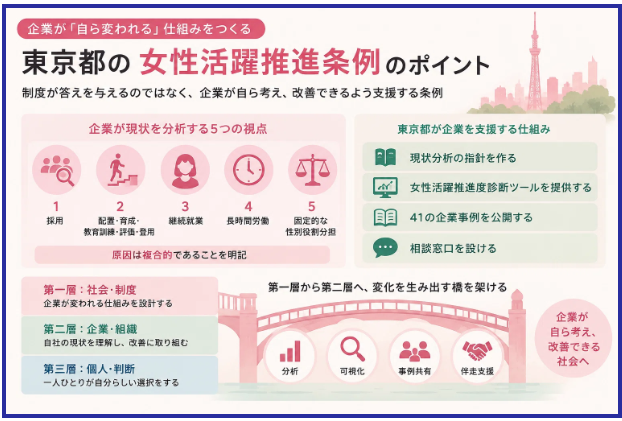
東京都の「女性活躍推進条例」を読んでいて、興味深いことがありました。
この条例は、企業に「女性管理職を○%にしなさい」と一律の答えを与えるものではありません。
むしろ東京都がつくろうとしているのは、
企業が自ら現状を理解し、変わっていくための仕組み
でした。
企業自身に「分析」を求める
条例では、企業が自社の状況を、
- 採用
- 配置・育成・教育訓練・評価・登用
- 継続就業
- 長時間労働
- 固定的な性別役割分担
という複数の視点から分析し、その結果を踏まえて取り組むことが示されています。
また、女性活躍を阻む原因についても、一つの要因だけで説明するのではなく、複合的に捉えるという考え方が置かれています。
制度だけでなく、企業が動くための環境をつくる
さらに東京都は、企業に分析や改善を求めるだけではなく、
現状を分析するための指針
診断ツール
企業事例
相談・支援
など、企業自身が取り組みを進めるための環境も整えています。
ここが特に興味深いと感じました。
第一層である社会・制度が、第二層である企業・組織に直接「こう変わりなさい」と答えを与えるのではない。
企業が自ら分析し、可視化し、考え、改善できるように、その間に橋を架けている。
そんな構造に見えます。
3つの層で見る
Women Impact Studioでは、人と組織を取り巻く構造を3つの層から観察しています。
第一層:社会・制度
企業を取り巻く法律、制度、社会からの要請。
第二層:企業・組織
企業がつくる制度、配置、育成、評価、組織環境。
第三層:個人・判断
その環境の中で、一人ひとりがどのように判断するのか。
今回の条例をこの3層で見ると、第一層が第二層を動かすために、
分析 → 可視化 → 事例共有 → 伴走支援
という仕組みを設計していることが見えてきました。
制度そのものを見るだけでなく、
「第一層は、第二層をどう動かそうとしているのか」
という視点で制度を見る。
第二層Observation Projectを続けながら、企業を取り巻く第一層についても観察していきたいと思います。
How Is Layer 1 Trying to Influence Layer 2?
Through the Layer 2 Observation Project, I read the Annual Securities Reports of Japanese companies to observe Layer 2 — the organizational environment that companies are trying to create.
As I continued observing companies, I became increasingly interested in what surrounds them: Layer 1 — society, policy and institutional systems.
Tokyo’s ordinance promoting women’s advancement provided an interesting example.
Rather than simply instructing companies to achieve a uniform percentage of women in management, the approach appears to focus on something different:
creating mechanisms that enable companies to understand their own situation and improve it themselves.
Asking companies to analyze their own organizations
The framework encourages companies to examine their current situation from several perspectives, including:
- recruitment
- assignment, development, training, evaluation and promotion
- continued employment
- long working hours
- fixed gender-role assumptions
It also recognizes that barriers to women’s advancement do not necessarily have a single cause. They can arise from multiple, interconnected factors.
Creating an environment in which companies can act
The Tokyo Metropolitan Government does more than ask companies to analyze and improve.
It also provides mechanisms to support that process, including:
guidance for analyzing current conditions
diagnostic tools
examples from other companies
consultation and support
This is what I found particularly interesting.
Layer 1 — society and institutions — is not simply telling Layer 2 — companies and organizations — exactly how to change.
Instead, it appears to be building a bridge that helps companies analyze, visualize, think and improve for themselves.
Looking through three layers
Women Impact Studio observes people and organizations through three layers:
Layer 1: Society and institutions
Laws, policies, systems and expectations surrounding companies.
Layer 2: Companies and organizations
Organizational systems, development, assignment, evaluation and working environments.
Layer 3: Individual decision-making
How individuals make decisions within those environments.
Viewed through this framework, Tokyo’s approach illustrates how Layer 1 can seek to influence Layer 2 through a sequence such as:
Analyze → Visualize → Share examples → Support action
Rather than looking only at what a policy requires, I am becoming interested in another question:
How is Layer 1 designed to influence Layer 2?
As the Layer 2 Observation Project continues, I will also observe the Layer 1 environment surrounding companies.
コメントを残す