日本語(English follows below)
人的資本・サステナビリティ・女性活躍・コーポレートガバナンスは、どうつながってきたのか
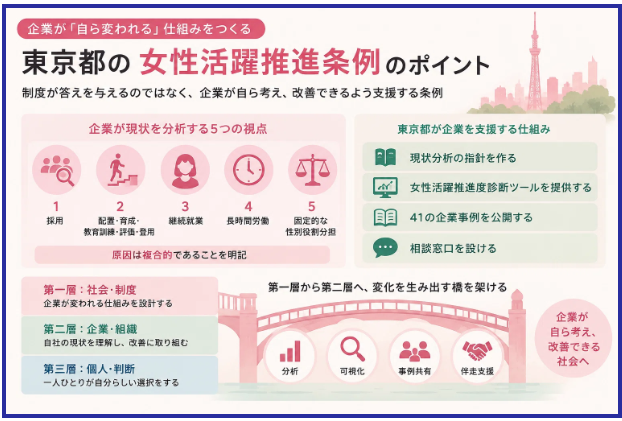
有価証券報告書を読みながら企業の「第二層=組織環境」を観察していると、その外側にある制度や社会からの要請も、企業の人材戦略に大きく影響していることが見えてきます。
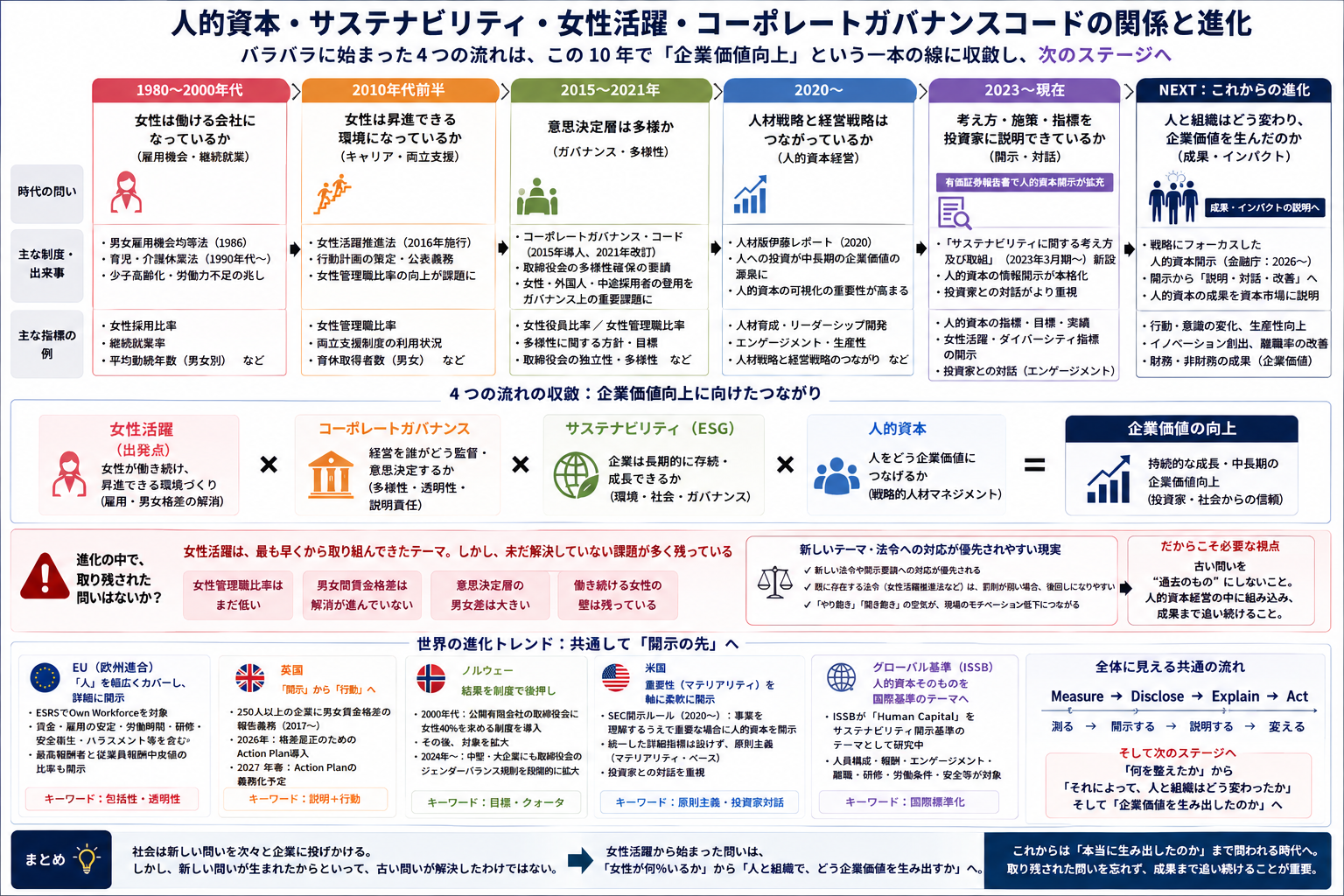
そこで今回は少し視点を広げ、人的資本、サステナビリティ、女性活躍、コーポレートガバナンスという4つの流れを時系列に並べてみました。
並べてみると、別々に進んできたように見える4つのテーマが、次第に**「企業は、人と組織の力を使ってどのように持続的な企業価値を生み出すのか」**という一つの問いに近づいているように見えます。
社会から企業への問いは変化してきた
女性活躍では、当初、
「女性が働き続けられるか」
「女性が昇進できるか」
という問いが中心でした。
コーポレートガバナンス改革が進むと、
「意思決定をする人たちは多様か」
という問いが加わります。
サステナビリティでは、
「企業が長期的に成長し続けるために何が必要か」
人的資本では、
「人材戦略と経営戦略はつながっているか」
そして現在は、
「その考え方、施策、指標、実績を投資家やステークホルダーに説明できるか」
というところまで、問いが広がってきました。
世界でも「開示」の先へ
海外でも進み方はさまざまです。
EUでは、人に関するより幅広い情報の開示が進み、英国では男女間賃金格差を測り、開示し、その先の行動へつなげる動きがあります。
取締役会のジェンダーバランスを制度面から促す国もあれば、投資家にとって重要な人的資本情報の開示を求める市場もあります。
さらに、国際的なサステナビリティ開示の議論でもHuman Capitalは重要なテーマになっています。
方向は一つではありませんが、大きな流れとして、
Measure → Disclose → Explain → Act
「測る」
→「開示する」
→「説明する」
→「行動する」
という進化が見えてきます。
その先では、
何を整備したのかではなく、
その結果、人と組織はどう変わったのか。
そして、それはどのような企業価値につながったのか。
という問いが、より重要になるのではないかと考えています。
進化の中で、取り残された問いはないか
一方、この流れを並べてみると、もう一つ気になることがあります。
新しい問いが生まれたからといって、以前の問いが解決したわけではありません。
・女性管理職比率。
・男女間賃金格差。
・意思決定層の男女差。
・働き続けられる環境。
女性活躍は長く取り組まれてきたテーマだからこそ、「すでに取り組んでいるテーマ」と認識されやすいのかもしれません。
しかし、
「長く取り組んできた」ことと、
「解決した」ことは違います。
ガバナンス、サステナビリティ、人的資本へと企業を取り巻くテーマが進化していく中で、以前から存在する課題を置き去りにしないことも重要だと思います。
「何をしたか」から「何が変わったか」へ
・研修を実施した。
・制度を作った。
・目標を設定した。
そこで終わるのではなく、
制度・施策
↓
人の行動や意思決定
↓
組織の変化
↓
事業成果
↓
企業価値
まで追っていく。
人的資本、サステナビリティ、女性活躍、コーポレートガバナンスを別々のテーマとして扱うのではなく、企業がどのような価値を生み出そうとしているのかという一つのストーリーとして見る。
今回4つの流れを並べてみて、そんなつながりが見えてきました。
第二層Observation Projectでは、引き続き有価証券報告書を読みながら企業の組織環境を観察すると同時に、その企業を取り巻く「第一層」の変化についても観察していきます。
How Human Capital, Sustainability, Women’s Advancement and Corporate Governance Have Converged
As I continue observing Layer 2 — the organizational environment — through the Annual Securities Reports of Japanese companies, I have also become increasingly interested in the external forces shaping those environments.
This led me to step outside Layer 2 for a moment and place four developments on the same timeline: women’s advancement, corporate governance, sustainability, and human capital.
Viewed together, these themes, which developed through different routes, appear to be converging around a common question:
How does a company use the capabilities of its people and organization to create sustainable corporate value?
The questions being asked of companies have evolved
Women’s advancement initially centered on questions such as:
Can women continue working?
Can women advance into leadership?
Corporate governance reform added another question:
Are the people making important decisions sufficiently diverse?
Sustainability broadened the perspective further:
What does a company need in order to continue creating value over the long term?
Human capital introduced a closer connection between people and strategy:
Is human capital strategy connected to business strategy?
And today, another question is becoming increasingly important:
Can the company explain its thinking, actions, indicators and results to investors and other stakeholders?
Moving beyond disclosure
International developments differ by jurisdiction.
The EU has expanded disclosure relating to people and sustainability. In the UK, gender pay gap reporting has increased visibility around disparities and the actions taken in response. Other countries have introduced mechanisms to promote gender balance at board level.
Human capital information is also increasingly viewed through the lens of investor relevance, while Human Capital itself is becoming an important area of international sustainability disclosure research.
Although these approaches differ, I see a broader progression:
Measure → Disclose → Explain → Act
First, measure.
Then disclose.
Then explain.
And ultimately, act.
The next question may go even further:
Not simply what systems or initiatives were introduced, but what actually changed in people and organizations — and whether those changes contributed to corporate value.
Are any questions being left behind?
Looking at this evolution raised another question for me.
When new questions emerge, do some of the older ones remain unresolved?
The proportion of women in management.
Gender pay gaps.
Gender differences in decision-making positions.
Whether people can continue working and progressing in their careers.
Women’s advancement has been on the corporate agenda for a long time. Precisely because of that, it can easily be perceived as something companies are already addressing.
But:
Working on an issue for a long time
is not the same as solving it.
As companies respond to governance, sustainability, human capital and new disclosure requirements, it is important that longstanding issues do not quietly disappear from view.
From “what we did” to “what changed”
Training was provided.
A new system was introduced.
A target was established.
The story should not necessarily end there.
Policies and interventions
↓
Changes in individual behaviour and decision-making
↓
Changes in the organization
↓
Business outcomes
↓
Corporate value
Rather than treating human capital, sustainability, women’s advancement and corporate governance as separate agendas, perhaps they can be understood as parts of a single story:
How does this company intend to create value, and how do its people and organization make that possible?
Putting these four developments on the same timeline helped me see that connection more clearly.
Through the Layer 2 Observation Project, I will continue observing organizational environments through Japanese companies’ Annual Securities Reports, while also looking at the Layer 1 changes surrounding those companies.