タグ: Layer 2 Observation Project

  • 森永製菓の人的資本を有価証券報告書から読む

    森永製菓の人的資本を有価証券報告書から読む

    第二層観察プロジェクト #017

    森永製菓の人的資本を有価証券報告書から読む

    人的資本経営が注目される中、企業は実際にどのような環境を整えようとしているのでしょうか。

    このシリーズでは、企業が正式に開示した有価証券報告書だけを読み、企業が整えようとしている**第2層(組織・環境)**を観察していきます。


    ① 森永製菓の目指すところ

    森永製菓は、2030年に向けて、

    「ウェルネスカンパニーへ生まれ変わります。」

    というビジョンを掲げています。

    ここでいうウェルネスとは、心・体・環境を基盤に、豊かで輝く人生を追求・実現している状態です。

    その実現に向け、5つのマテリアリティの一つに**「多様な人材の活躍」**を位置付けています。

    人的資本では、一人ひとりが主体的にキャリアを形成するプロティアン・キャリアの考え方を中心に置き、人的資本の価値を最大化するための投資を進めています。


    ② 女性育成の位置付け

    森永製菓は、D&Iを経営戦略の中核に位置付けています。

    特徴的だったのは、女性だけを切り離して考えるのではなく、女性やシニアなどを含め、**「一人ひとりの個を活かす」**という考え方の中で捉えていることでした。

    さらに、社内調査からジェンダーに起因する意識や機会のギャップを課題として捉え、2025年度から**「Gempower PROGRAM」**を開始しています。

    GenderとGenerationの視点を取り入れ、意識改革と機会創出の両面から、社員が主体的にキャリアを描き、挑戦できる環境づくりを進めています。


    ③ 第二層の成熟度

    森永製菓では、働く環境だけでなく、キャリア形成から次世代リーダー育成まで、幅広く第2層が設計されていました。

    働く環境

    • 女性専用休憩室「エンゼルルーム」
    • オールジェンダートイレ
    • キャリア相談室
    • 育児と仕事の両立支援

    学ぶ機会

    • プロティアン・キャリアの考え方を取り入れたキャリア形成支援
    • Gempower PROGRAM
    • 女性に特化したキャリア研修
    • D&Iポリシー浸透研修
    • アンコンシャスバイアス研修
    • 6つの能力を軸とした計画的な能力開発

    キャリア・配置

    • 社内公募制度
    • キャリア採用
    • サクセッションプラン
    • 役員候補・部長候補・マネージャー候補という階層ごとの人材育成

    マネジメント

    • 役員候補者への8か月間の1対1プロフェッショナルコーチング
    • 30代のマネージャー候補への9か月間の育成
    • 新任職位者研修
    • 人材育成責任を含む管理職教育
    • 社長を委員長とする人事委員会

    制度を用意するだけではなく、人が成長していく過程そのものに働きかけていることが特徴的でした。


    ④ 私が立ち止まったところ

    今回は、一文ではなく、いくつもの記述で立ち止まりました。

    プロティアン・キャリアの考え方。

    女性とシニアをともに取り上げていること。

    役員候補者への8か月間の1対1コーチング。

    30代のマネージャー候補への9か月間の育成。

    6つの能力を定めた計画的な能力開発。

    そして、Gempower PROGRAM。

    一つひとつは異なる施策です。

    でも、読み進めているうちに、これらには共通する考え方があるように感じました。

    人の成長を、本人任せにしない。

    どんなキャリアを歩みたいのかを考える。

    必要な能力を明確にする。

    経験する機会をつくる。

    そして、時間をかけて育成する。

    森永製菓は、人が成長するプロセスそのものを第2層として設計しようとしているように見えました。


    ⑤ 私の観察

    これまで有価証券報告書を読んでいると、企業によって「人の育て方」がかなり違うことが見えてきました。

    制度を整える企業。

    挑戦する機会を増やす企業。

    女性管理職候補のパイプラインを太くしようとする企業。

    その中で森永製菓は、**「成長のプロセスを設計する」**会社のように感じました。

    特に興味深かったのは、役員候補者だけではありません。

    30代のマネージャー候補にも長期間の育成機会を設けています。

    管理職になってから育てるのではなく、その前から時間をかけて準備する。

    そして女性についても、単に「女性管理職を増やす」という数字だけではなく、Gempower PROGRAMなどを通じて、意識と機会の両方に働きかけています。

    つまり、この会社は、

    「人は、必要な能力を知り、経験する機会を得て、継続的に支援されることで成長する」

    と考えているように、私には見えました。

    100社を読み進めたとき、企業ごとの**「人はどうすれば成長するのか」**という考え方の違いも見えてくるかもしれません。


    ⑥ 第二層の思想

    今回の有価証券報告書から見えてきた森永製菓の第2層は、特定の一つの制度に特徴があるというより、複数の仕組みが**「成長するプロセス」**としてつながっていることでした。

    キャリアを考える。

    必要な能力を知る。

    経験する機会を得る。

    次の役割に向けて時間をかけて準備する。

    そして、その過程を組織が支える。

    そこから見えてくるのは、

    「人は、必要な能力を知り、経験する機会を得て、継続的に支援されることで成長する」

    という考え方です。

    本人の主体性を重視しながら、成長を本人任せにはしない。

    そこに、森永製菓の第2層の特徴があるように感じました。


    ⑦ Data(2025年度 有価証券報告書より)

    指標数値
    管理職に占める女性労働者の割合14.0%
    男性育児休業取得率80.0%
    男女賃金差異(全労働者)62.3%
    男女賃金差異(正規雇用労働者)64.8%
    男女賃金差異(パート・有期労働者)85.5%

    Women Impact Studioでは、第2層(組織・環境)と第3層(個人の判断)の両方を観察しています。第3層の見える化には、RUMIOSを用いています。

    Layer 2 Observation Project #017

    Reading Morinaga & Co.’s Human Capital Strategy Through Its Annual Securities Report

    As human capital management attracts increasing attention, what kind of organizational environment are companies actually trying to create?

    In this series, I read only companies’ officially disclosed Annual Securities Reports and observe the Layer 2 (organizational environment) they are building.


    1. What Is Morinaga Aiming For?

    Toward 2030, Morinaga has declared its vision:

    “We will transform ourselves into a Wellness Company.”

    The company defines wellness as a state in which people pursue and realize rich and fulfilling lives, based on the foundations of mind, body, and environment.

    To achieve this vision, Morinaga identifies “the active participation of diverse talent” as one of its five material issues.

    Its human capital approach incorporates the concept of a protean career, in which each employee proactively shapes their own career, while the company invests in maximizing the value of its human capital.


    2. Positioning of Women’s Development

    Morinaga positions D&I at the core of its management strategy.

    What caught my attention is that women are not treated as an isolated category.

    Instead, women, senior employees, and others are considered within a broader philosophy of making the most of each individual.

    Based on internal surveys, Morinaga has also identified gender-related gaps in awareness and opportunity.

    In FY2025, it launched the Gempower PROGRAM, incorporating both Gender and Generation perspectives.

    The program works on both mindset change and opportunity creation, aiming to create an environment where employees can proactively shape their careers and take on new challenges.


    3. Layer 2 Design

    Morinaga’s Layer 2 extends from the working environment to career development and next-generation leadership development.

    Work Environment

    • “Angel Room” rest spaces for women
    • All-gender restrooms
    • Career consultation services
    • Support for balancing childcare and work

    Learning Opportunities

    • Career development based on the protean career concept
    • Gempower PROGRAM
    • Career training specifically for women
    • D&I policy training
    • Unconscious bias training
    • Planned development based on six defined capabilities

    Career and Placement

    • Internal job posting
    • Mid-career recruitment
    • Succession planning
    • Development by leadership level, including executive, department head, and manager candidates

    Management

    • Eight months of one-on-one professional coaching for executive candidates
    • Nine months of development for manager candidates in their 30s
    • Training for newly appointed leaders
    • Management education that includes responsibility for developing people
    • A Human Resources Committee chaired by the president

    Rather than simply providing systems and programs, Morinaga appears to intervene in the process through which people grow.


    4. What Made Me Stop

    This time, it was not one sentence.

    I stopped at several different disclosures.

    The protean career concept.

    The fact that women and senior employees are discussed together.

    Eight months of one-on-one coaching for executive candidates.

    Nine months of development for manager candidates in their 30s.

    Planned development based on six capabilities.

    And the Gempower PROGRAM.

    These are different initiatives.

    But as I continued reading, I began to see a common idea connecting them:

    Do not leave people’s growth entirely to the individual.

    Think about the career you want.

    Understand the capabilities you need.

    Create opportunities to gain experience.

    And develop over time.

    Morinaga appears to be designing the growth process itself as part of Layer 2.


    5. My Observation

    As I continue reading Annual Securities Reports, I am beginning to see how differently companies think about developing people.

    Some design systems.

    Some increase opportunities to take on challenges.

    Some focus on strengthening the pipeline of potential women managers.

    Morinaga, however, struck me as a company that designs the process of growth itself.

    What I found particularly interesting was that this does not apply only to executive candidates.

    Manager candidates in their 30s are also given long-term development opportunities.

    Rather than waiting until someone becomes a manager to develop them, the preparation begins earlier and continues over time.

    For women, too, the approach goes beyond setting a numerical target for women in management.

    Through initiatives such as the Gempower PROGRAM, Morinaga works on both awareness and opportunity.

    This suggests to me that the company may believe:

    “People grow when they understand the capabilities they need, receive opportunities to gain experience, and are supported continuously over time.”

    As I continue toward 100 companies, perhaps the differences in how companies answer the question “How do people grow?” will become increasingly visible.


    6. Layer 2 Philosophy

    What stands out in Morinaga’s Annual Securities Report is not one particular system.

    It is how multiple mechanisms appear to connect as a process of growth.

    Think about your career.

    Understand the capabilities you need.

    Gain experience.

    Prepare over time for the next role.

    And receive organizational support throughout that process.

    The philosophy that emerges is:

    “People grow when they understand the capabilities they need, receive opportunities to gain experience, and are supported continuously over time.”

    Individual agency is important.

    But growth is not left entirely to the individual.

    That appears to be a distinctive feature of Morinaga’s Layer 2 design.


    7. Data

    Women in management: 14.0%

    Men taking childcare leave: 80.0%

    Gender pay gap — all employees: 62.3%

    Gender pay gap — regular employees: 64.8%

    Gender pay gap — part-time and fixed-term employees: 85.5%

    Women Impact Studio observes both Layer 2 (organizational environment) and Layer 3 (individual decision-making). RUMIOS is used to make Layer 3 visible.
  • ヤクルト本社の人的資本を有価証券報告書から読む

    ヤクルト本社の人的資本を有価証券報告書から読む

    第二層観察プロジェクト #016

    ヤクルト本社の人的資本を有価証券報告書から読む

    人的資本経営が注目される中、企業は実際にどのような環境を整えようとしているのでしょうか。

    このシリーズでは、企業が正式に開示した有価証券報告書だけを読み、企業が整えようとしている**第2層(組織・環境)**を観察していきます。


    ① ヤクルト本社の目指すところ

    ヤクルト本社は、

    「私たちは、生命科学の追究を基盤として、世界の人々の健康で楽しい生活づくりに貢献します」

    という企業理念を掲げています。

    長期ビジョン「Yakult Group Global Vision 2030」では、

    「世界の人々の健康に貢献し続けるヘルスケアカンパニーへの進化」

    を目指しています。

    人的資本については、中期経営計画(2025-2030)の中で、人的資本の強化を重要な経営課題と位置付けています。


    ② 女性育成の位置付け

    有価証券報告書では、ダイバーシティ&インクルージョンを、

    「企業経営に欠くことのできないもの」

    と位置付け、多様な人材が個性と能力を最大限発揮できる企業風土を目指しています。

    女性管理職比率については、2030年度までに20%以上という目標を設定。

    女性向けキャリア研修だけでなく、一般職から総合職への転換の推奨、女性・外国人・中途採用者の管理職への登用なども進めています。


    ③ 第二層の成熟度

    ヤクルト本社では、働き方だけでなく、キャリアの入口そのものにも手を入れていることが特徴的でした。

    働く環境

    • 週休3日制
    • 在宅勤務
    • 副業制度
    • 育児・介護支援
    • 男性の育児休業取得促進

    学ぶ機会

    • 女性向けキャリア研修
    • 「個」のキャリアに合わせた教育
    • イノベーティブな人材の育成
    • グローバルに活躍できる人材の育成
    • 組織力向上に貢献できる人材の育成

    キャリア・配置

    • 一般職から総合職への転換の推奨
    • 女性の管理職登用
    • 外国人の管理職登用
    • 中途採用者の管理職登用

    マネジメント

    • ダイバーシティ&インクルージョンを「企業経営に欠くことのできないもの」と位置付け
    • 多様な人材が個性と能力を最大限発揮できる企業風土づくり
    • 人的資本・人材戦略を中期経営計画と連動して推進

    一方、管理職そのものに働きかける研修や、女性の育成・登用についてマネジメント側がどのように関与するのかといった具体的な仕組みについては、有価証券報告書では詳しく確認できませんでした。

    4つを並べてみると、ヤクルト本社では特に**「キャリア・配置」への働きかけ**に特徴があるように見えます。


    ④ 私が立ち止まった一文

    「具体的には、一般職から総合職への転換の推奨、女性・外国人・中途採用者の管理職への登用等、さまざまな施策を展開しています。」

    この一文に立ち止まりました。

    男女雇用機会均等法が施行されても、日本企業では長く「総合職」と「一般職」というコース別の雇用管理が存在してきました。

    そして、多くの女性が一般職として採用され、管理職を目指す以前に、そもそも管理職につながるキャリアのレールに乗りにくい構造がありました。

    だから私は、「一般職から総合職への転換を推奨する」と有価証券報告書に明記していることに目が止まりました。

    女性を研修するだけではない。

    管理職を目指せる入口そのものを広げようとしている。

    これは第2層を考えるうえで、とても重要な取り組みだと思います。

    もう一つ興味深かったのが、「女性・外国人・中途採用者」を並べて管理職への登用対象としていることです。

    私は長く外資系企業で働いてきましたが、中途採用者が管理職になることは珍しいことではありませんでした。

    それをあえて明記しているところにも、日本企業の従来の人材パイプラインを変えようとする動きが見えるように感じました。


    ⑤ 私の観察

    女性管理職比率を見るとき、これまでは「何%いるのか」という結果を見ることが多かったように思います。

    でも100社の有価証券報告書を読み始めて、私はその手前を見るようになりました。

    そもそも、その会社では誰が管理職候補になれるのでしょうか。

    女性向け研修を用意する。

    メンタリングをする。

    管理職候補者を育成する。

    それももちろん第2層です。

    でも、管理職につながるキャリアルートへの入口そのものが狭ければ、その先のパイプラインも太くなりません。

    ヤクルト本社が行っている「一般職から総合職への転換の推奨」は、まさにそこに手を入れる取り組みです。

    さらに男性の育児休業についても、2030年度までに全対象者の取得だけでなく、平均取得期間45日以上を目標としています。

    2025年度実績は取得率103.2%、平均取得期間44日でした。

    女性本人だけに働きかけるのではなく、

    キャリアの入口を広げる。
    管理職になれる人の範囲を広げる。
    家庭における男性の役割も変える。

    ヤクルト本社の有価証券報告書からは、そんな複数の方向から第2層を動かそうとする姿が見えてきました。

    そして今回、100社を比較するうえで、新しい観察軸が一つ見えてきたように思います。

    「女性管理職をどう育てるか」だけではなく、「そもそも誰が管理職へのレールに乗れるように設計されているのか」。

    この視点でも、これからの企業を観察していきたいと思います。


    ⑥ 第二層の思想

    今回の有価証券報告書からは、ヤクルト本社は、

    「人は、キャリアの入口が開かれることで、これまで選びにくかった次の役割へ進める」

    と考えているように見えました。

    女性を管理職候補として育成するだけではなく、一般職から総合職への転換を促す。

    女性だけではなく、外国人や中途採用者も管理職へ登用する。

    つまり、すでに管理職へのレールに乗っている人を育てるだけではなく、誰がそのレールに乗れるのかという入口そのものを広げる。

    そこに、ヤクルト本社の第2層の特徴があるように感じました。


    ⑦ Data(2025年度 有価証券報告書より)

    指標数値
    管理職に占める女性労働者の割合14.4%
    男性育児休業取得率103.2%
    男女賃金差異(全労働者)67.9%
    男女賃金差異(正規雇用労働者)73.6%
    男女賃金差異(パート・有期労働者)40.7%

    Women Impact Studioでは、第2層(組織・環境)と第3層(個人の判断)の両方を観察しています。第3層の見える化には、RUMIOSを用いています。

    Layer 2 Observation Project #016

    Reading Yakult Honsha’s Human Capital Strategy Through Its Annual Securities Report

    As human capital management attracts increasing attention, what kind of organizational environment are companies actually trying to create?

    In this series, I read only companies’ officially disclosed Annual Securities Reports and observe the Layer 2 (organizational environment) they are building.


    1. What Is Yakult Honsha Aiming For?

    Yakult Honsha’s corporate philosophy is:

    “We contribute to the health and happiness of people around the world through pursuit of excellence in life science in general and our research and experience in microorganisms in particular.”

    Under “Yakult Group Global Vision 2030,” the company aims to evolve into a healthcare company that continues contributing to the health of people around the world.

    Its Medium-term Management Plan (2025–2030) identifies the strengthening of human capital as an important management priority.


    2. Positioning of Women’s Development

    In its Annual Securities Report, Yakult positions diversity and inclusion as:

    “indispensable to corporate management.”

    It aims to create a corporate culture in which diverse people can fully demonstrate their individuality and abilities.

    The company has set a target of at least 20% women in management by FY2030.

    Its initiatives include not only career training for women, but also encouraging transfers from clerical-track to career-track positions and promoting women, non-Japanese employees, and mid-career hires into management.


    3. Layer 2 Design

    One distinctive feature of Yakult’s approach is that it appears to intervene not only in working conditions and development, but also in who can enter particular career pathways.

    Work Environment

    • Three-day weekends
    • Remote work
    • Side-job arrangements
    • Childcare and nursing-care support
    • Encouraging men to take childcare leave

    Learning Opportunities

    • Career training for women
    • Education tailored to individual careers
    • Development of innovative talent
    • Development of globally capable talent
    • Development of people who can contribute to organizational capability

    Career and Placement

    • Encouraging transfers from clerical-track to career-track positions
    • Promotion of women into management
    • Promotion of non-Japanese employees into management
    • Promotion of mid-career hires into management

    Management

    • Positioning D&I as indispensable to corporate management
    • Creating a culture where diverse people can fully demonstrate their abilities
    • Linking human capital and talent strategy with the Medium-term Management Plan

    On the other hand, detailed mechanisms showing how managers themselves are involved in developing and promoting women were not clearly identifiable in the Annual Securities Report.

    Looking across these areas, Yakult appears particularly distinctive in its intervention in career pathways and placement.


    4. A Sentence That Made Me Stop

    The report states that Yakult is:

    encouraging transfers from clerical-track to career-track positions and promoting women, non-Japanese employees, and mid-career hires into management.

    This made me stop.

    Even after Japan’s Equal Employment Opportunity Law came into effect, many Japanese companies continued to operate separate career tracks.

    Many women were hired into clerical-track positions.

    This meant that, long before deciding whether to become a manager, many women were not necessarily on the career track that typically led to management in the first place.

    That is why Yakult’s explicit reference to encouraging transfers from clerical-track to career-track positions caught my attention.

    It is not only about training women.

    It is about widening the entrance to a career path that can lead to management.

    I also found it interesting that the report explicitly mentions women, non-Japanese employees, and mid-career hires together as groups being promoted into management.

    Having worked in foreign financial institutions for many years, I was accustomed to seeing mid-career hires become managers.

    The fact that this is explicitly stated in the report made me wonder whether we are seeing an effort to change a more traditional Japanese talent pipeline.


    5. My Observation

    When looking at women in management, we often focus on the result:

    What percentage of managers are women?

    But after reading Annual Securities Reports from company after company, I have started looking one step earlier.

    Who is able to become a management candidate in the first place?

    Training women.

    Providing mentoring.

    Developing management candidates.

    These are all important elements of Layer 2.

    But if the entrance to the career pathway leading to management is narrow, the pipeline beyond it cannot easily become wider.

    Yakult’s encouragement of transfers from clerical-track to career-track positions intervenes precisely at that point.

    Its approach to men’s childcare leave is also notable.

    By FY2030, Yakult aims not only for all eligible men to take childcare leave, but also for an average leave period of at least 45 days.

    In FY2025, the reported figures were 103.2% for the leave-taking rate and an average of 44 days.

    Rather than intervening only with women:

    Widen the entrance to career pathways.
    Widen the range of people who can become managers.
    Change men’s roles at home as well.

    The Annual Securities Report suggests that Yakult is attempting to move Layer 2 from several directions.

    And this gave me another question to carry into the remaining companies in this 100-company observation:

    Not only “How does the company develop women managers?” but “Who is the organization designed to allow onto the path toward management in the first place?”


    6. Layer 2 Philosophy

    From this Annual Securities Report, Yakult appears to believe:

    “People can move toward roles that were previously difficult to choose when the entrance to the career path is opened.”

    Rather than only developing people already on the management track, Yakult is also widening access to that track.

    Encouraging transfers from clerical-track to career-track positions.

    Promoting women, non-Japanese employees, and mid-career hires into management.

    In other words, the intervention begins one step earlier:

    Who gets to enter the pipeline in the first place?

    That appears to be one of the distinctive features of Yakult’s Layer 2 design.


    7. Data

    Women in management: 14.4%

    Men taking childcare leave: 103.2%

    Gender pay gap — all employees: 67.9%

    Gender pay gap — regular employees: 73.6%

    Gender pay gap — part-time and fixed-term employees: 40.7%

    Women Impact Studio observes both Layer 2 (organizational environment) and Layer 3 (individual decision-making). RUMIOS is used to make Layer 3 visible.
  • ニチレイの人的資本を有価証券報告書から読む

    ニチレイの人的資本を有価証券報告書から読む

    第二層観察プロジェクト#15

    ニチレイの人的資本を有価証券報告書から読む

    人的資本経営が注目される中、企業は実際にどのような環境を整えようとしているのでしょうか。

    このシリーズでは、企業が正式に開示した有価証券報告書だけを読み、企業が整えようとしている**第2層(組織・環境)**を観察していきます。


    ① ニチレイの目指すところ

    ニチレイは、

    「食からひろがる幸せを、ニチレイが未来へつなぐ」

    をミッションに掲げています。

    長期経営目標「N-FIT 2035」の実現に向け、人財戦略では「経営人財」「海外人財」「DX・IT人財」を重点領域とし、その基盤の一つとしてDE&Iを位置付けています。


    ② 女性育成の位置付け

    女性活躍は、マテリアリティである**「多様な人財の確保と育成」**の中に位置付けられています。

    2024年度には持株会社に「ダイバーシティ推進部」を設置。

    さらに、女性管理職比率を役員報酬のESG評価指標の一つに組み込み、2030年度には国内主要会社の女性管理職比率30%を目標に掲げています。


    ③ 第二層の成熟度

    ニチレイでは、女性管理職を増やすための仕組みが少しずつ体系化されています。

    働く環境

    • 年間休日日数を120日に拡大
    • オペレーション業務の自動化・省力化

    学ぶ機会

    • 自発的な通信教育・各種研修
    • 経営人財・海外人財・DX・IT人財への重点投資
    • 語学研修・異文化理解・海外拠点への短期派遣

    キャリア・配置

    • グループ横断の女性活躍推進プロジェクト
    • グループ女性育成プログラム
    • 女性管理職候補者への研修
    • 女性役員との面談

    マネジメント

    • ダイバーシティ推進部
    • 国内主要会社役員へのダイバーシティ勉強会
    • グループ人財委員会

    特に女性育成については、管理職候補者の育成だけではなく、登用、登用後の定着、さらに次の役割への成長までを見据えたプログラムとして整理されています。


    ④ 私が立ち止まった一文

    「女性活躍の推進においては、グループ横断での女性活躍推進PJを立ち上げ、PJメンバーによる現場目線での女性活躍に向けた課題解決や、女性管理職候補者に対する研修や、女性役員との面談を通じてキャリアを考える機会を作るなど、計画的に女性管理職を増やす取り組みを進めており、実際に管理職に登用される女性社員が増加しております。」

    この一文に立ち止まりました。

    今回の有価証券報告書は、全体としてはとても淡々と書かれている印象を受けました。

    その中で目に留まったのが、**「女性役員との面談」**です。

    管理職になるかどうかを考えている女性にとって、研修で管理職について学ぶことと、実際にその先を歩いている女性と話すことは、少し違うように思います。

    自分がまだ見たことのないキャリアを、実際にそこにいる人を通して見ることができる。

    以前、KDDIの有価証券報告書を読んだとき、社内イベントの登壇者に女性または39歳以下を一定割合入れる「パネルガイドライン」が印象に残りました。

    私は、「見える景色」は人の選択肢に影響すると思っています。

    女性役員と直接話す機会をつくることもまた、女性管理職候補者に見える景色を変える第2層の一つなのかもしれません。


    ⑤ 私の観察

    もう一つ興味深かったのは、この一文が「研修を実施した」で終わっていないことです。

    女性活躍推進プロジェクトをつくる。

    現場目線で課題を考える。

    管理職候補者を育成する。

    女性役員と話す機会をつくる。

    そして、

    「実際に管理職に登用される女性社員が増加している」

    と、その先の変化まで書かれています。

    また、男女賃金差異についても、ニチレイは一般社員では差異が少なく、管理職層で差異が大きいこと、その背景に女性管理職の少なさがあると説明しています。

    課題を認識し、女性管理職を増やす仕組みをつくり、その結果まで追う。

    有価証券報告書の語り口そのものは淡々としていましたが、書かれている取り組みをつないでみると、女性が管理職になるまで、そして管理職になった後までを一つのパイプラインとして整えようとしていることが見えてきました。

    今後100社を比較することで、企業によって女性のキャリアのどこに働きかけようとしているのか、その違いも観察していきたいと思います。


    ⑥ 第二層の思想

    今回の有価証券報告書からは、ニチレイは、

    「人は、次のキャリアを実際に見ることができ、そのための経験と機会がつながることで、次の役割へ進みやすくなる」

    と考えているように見えました。

    女性管理職候補者を育成する。

    女性役員と直接話す機会をつくる。

    管理職へ登用する。

    そして、登用後の定着や次の成長まで支える。

    一つひとつの施策を単独で置くのではなく、女性のキャリアを一つのパイプラインとしてつなげていく。

    そこに、ニチレイの第2層の特徴があるように感じました。


    ⑦ Data(2025年度 有価証券報告書より)

    指標数値
    管理職に占める女性労働者の割合(ニチレイ単体)28.3%
    女性管理職比率(国内主要会社)11.1%
    男性育児休業取得率66.7%
    男女賃金差異(全労働者)74.9%
    男女賃金差異(正規雇用労働者)78.1%
    男女賃金差異(非正規雇用労働者)50.4%

    Women Impact Studioでは、第2層(組織・環境)と第3層(個人の判断)の両方を観察しています。第3層の見える化には、RUMIOSを用いています。

    Layer 2 Observation Project #015

    Reading Nichirei’s Human Capital Strategy Through Its Annual Securities Report

    As human capital management attracts increasing attention, what kind of organizational environment are companies actually trying to create?

    In this series, I read only companies’ officially disclosed Annual Securities Reports and observe the Layer 2 (organizational environment) they are building.


    1. What Is Nichirei Aiming For?

    Nichirei’s mission is:

    “We connect the joy of food to the future.”

    To achieve its long-term management goals under “N-FIT 2035,” its human capital strategy focuses on management talent, global talent, and DX/IT talent, with DE&I positioned as one of the foundations supporting these priorities.


    2. Positioning of Women’s Development

    Women’s advancement is positioned within the material issue of “securing and developing diverse talent.”

    In FY2024, Nichirei established a Diversity Promotion Department at the holding company.

    The percentage of women in management is also incorporated into ESG-related executive compensation indicators.

    By FY2030, Nichirei aims to increase the percentage of women in management at its major domestic companies to 30%.


    3. Layer 2 Design

    Nichirei appears to be gradually building a more systematic structure for developing women managers.

    Work Environment

    • Increasing annual holidays to 120 days
    • Automation and labor-saving measures in operational work

    Learning Opportunities

    • Voluntary correspondence courses and training
    • Focused investment in management, global, and DX/IT talent
    • Language training, cross-cultural learning, and short-term assignments at overseas locations

    Career and Placement

    • Group-wide women’s advancement project
    • Group development program for women
    • Training for potential women managers
    • Meetings with women executives

    Management

    • Diversity Promotion Department
    • Diversity study sessions for executives of major domestic companies
    • Group Human Resources Committee

    What particularly stood out is that the approach extends beyond developing management candidates to consider promotion, retention after promotion, and further growth into subsequent roles.


    4. A Sentence That Made Me Stop

    The report describes a group-wide women’s advancement project, training for potential women managers, opportunities to discuss careers with women executives, and notes that the number of women actually promoted into management is increasing.

    One element particularly caught my attention:

    “meetings with women executives.”

    For a woman considering whether to move into management, learning about management through training and speaking directly with a woman who has already progressed further along that path are not quite the same thing.

    It allows someone to see a career she has not yet experienced through a person who is actually living it.

    When I previously read KDDI’s Annual Securities Report, I was struck by its “Panel Guidelines,” which intentionally increase the visibility of women and younger employees at internal events.

    I believe what people can see influences what they perceive as possible.

    Creating opportunities to speak directly with women executives may similarly change the landscape visible to potential women managers.


    5. My Observation

    Another interesting point is that Nichirei’s disclosure does not end with:

    “We conducted training.”

    It describes a sequence.

    Create a women’s advancement project.

    Identify issues from the perspective of the workplace.

    Develop potential women managers.

    Create opportunities to speak with women executives.

    And then observe that:

    the number of women actually promoted into management is increasing.

    Nichirei also explains its gender pay gap by noting that the gap is relatively small among non-management employees but larger at management level, partly because there are fewer women managers.

    In other words:

    Identify the issue.

    Build mechanisms to increase women in management.

    And observe what changes as a result.

    The tone of the Annual Securities Report itself is understated.

    But when the individual initiatives are connected, a broader structure becomes visible:

    Nichirei appears to be building a pipeline that extends from becoming a management candidate, through promotion, and into continued growth after promotion.

    As I continue comparing 100 companies, I want to observe where along women’s careers different organizations choose to intervene.


    6. Layer 2 Philosophy

    From this Annual Securities Report, Nichirei appears to believe:

    “People are more able to move into their next role when they can see what that career looks like and when the experiences and opportunities leading to it are connected.”

    Develop potential women managers.

    Give them opportunities to speak directly with women executives.

    Promote them into management.

    Then support their retention and further growth.

    Rather than treating each initiative separately, Nichirei appears to be connecting women’s careers as a continuous pipeline.

    That seems to be one of the distinctive features of its Layer 2 design.


    7. Data

    Women in management (Nichirei Corporation): 28.3%

    Women in management (major domestic companies): 11.1%

    Men taking childcare leave: 66.7%

    Gender pay gap — all employees: 74.9%

    Gender pay gap — regular employees: 78.1%

    Gender pay gap — non-regular employees: 50.4%

    Women Impact Studio observes both Layer 2 (organizational environment) and Layer 3 (individual decision-making). RUMIOS is used to make Layer 3 visible.

  • 企業は、人はどうすれば変わると考えているのか

    企業は、人はどうすれば変わると考えているのか

    日本語(English follows below)

    10社読んで見えてきた。「企業は、人はどうすれば変わると考えているのか」

    第二層観察プロジェクトで、日本企業の有価証券報告書を読み始めて10社。

    これまで私は、各社について、

    「どんな制度があるのか」
    「女性管理職比率は何%か」
    「どんな人材育成をしているのか」

    を見てきました。

    でも10社を並べてみると、もう一段奥に、違いがあるように見えてきました。

    企業によって、「人はどうすれば変わるのか」という考え方が違う。

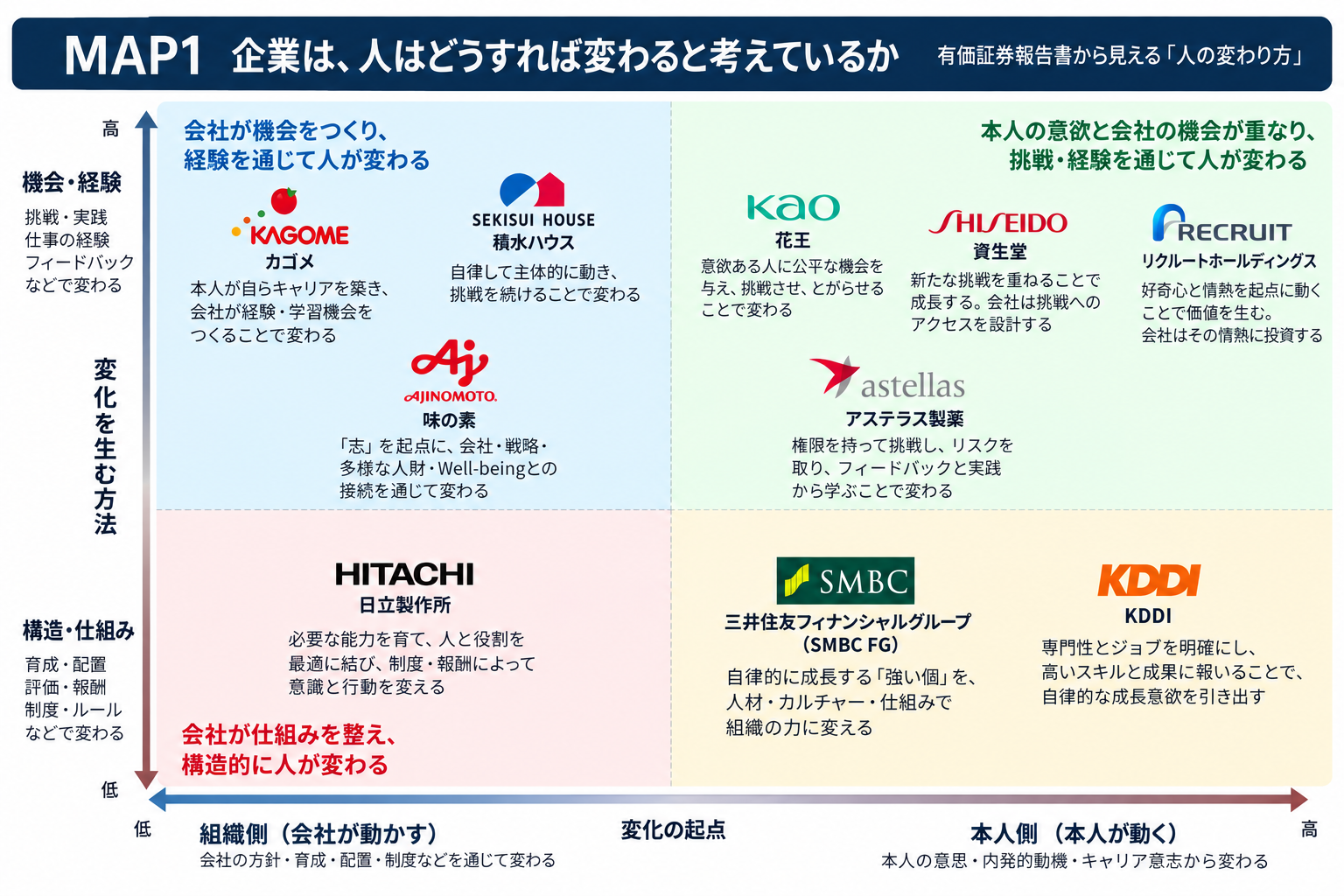
    そこで、最初の10社を2つの軸で置いてみました。

    横軸は、変化の起点。

    左に行くほど「組織側が動かす」。
    右に行くほど「本人が動く」。

    縦軸は、変化を生む方法。

    上に行くほど「機会・経験によって変わる」。
    下に行くほど「仕組み・構造によって変わる」。

    すると、同じ「人的資本経営」という言葉の下にある違いが見えてきました。

    カゴメは、
    本人が自らキャリアを築き、会社が経験・学習機会をつくることで、人は変わる。

    積水ハウスは、
    自律して主体的に動き、挑戦を続けることで、人は変わる。

    日立製作所は、
    必要な能力を育て、人と役割を最適に結び、制度・報酬によって意識と行動を変える。

    味の素は、
    「志」を起点に、会社・戦略・多様な人財・Well-beingとの接続を通じて挑戦を生む。

    花王は、
    意欲ある人に公平な機会を与え、挑戦させ、とがらせることで、人は変わる。

    資生堂は、
    新たな挑戦を重ねることで成長する。会社は挑戦へのアクセスを設計する。

    アステラス製薬は、
    権限を持って挑戦し、リスクを取り、フィードバックと実践から学ぶことで、人は変わる。

    KDDIは、
    専門性とジョブを明確にし、高いスキルと成果に報いることで、自律的な成長意欲を引き出す。

    リクルートHDは、
    好奇心と情熱を起点に動くことで価値を生む。会社はその情熱に投資する。

    SMFGは、
    自律的に成長する「強い個」を、人材・カルチャー・仕組みで組織の力に変える。

    もちろん、企業自身がこのように宣言しているわけではありません。

    私が有価証券報告書に記載された制度、人材育成、配置、マネジメント、ガバナンスを横に並べたときに見えてきた、現時点での「観察」です。

    だから、この地図は企業の優劣を示すものでもありません。

    むしろ興味深いのは、同じ目的に向かっていても、人が変わるために企業が触っている場所が違うことです。

    ・ある会社は、本人の自律を起点にする。
    ・ある会社は、挑戦や経験を変化の契機にする。
    ・ある会社は、専門性や役割を明確にする。
    ・ある会社は、人と役割を結び直す。
    ・ある会社は、制度や報酬まで使って行動を変える。

    制度を一つずつ見ているだけでは、この違いはあまり見えません。

    10社を横に並べて、初めて見えてきました。

    これはまだ、10社時点の仮説です。

    次の10社を加えたとき、この地図はそのまま成立するのか。
    新しい「人の変わり方」が現れるのか。
    今置いた企業の位置が動くのか。

    20社、30社……と増やしながら観察していきます。

    最終的には100社。

    日本企業が「人はどうすれば変わる」と考えているのか。

    有価証券報告書だけを材料に、その第二層を地図にしてみたいと思います。

    ※本マップは各社の有価証券報告書に記載された取り組み・方針をもとにした観察であり、企業の優劣を評価するものではありません。

    After Reading 10 Companies: How Do Companies Think People Change?

    As human capital management gains increasing attention, how are companies actually designing their organizational environments?

    In this series, I observe what I call Layer 2 (the organizational environment) by reading only the officially filed Annual Securities Reports of Japanese companies.

    I have now completed my first 10 companies.

    Until now, I have looked at questions such as:

    • What systems and programs does each company have?
    • What percentage of managers are women?
    • How does each company develop its people?

    But when I placed the first 10 companies side by side, another difference began to emerge.

    Companies seem to have different underlying assumptions about how people change.

    So I mapped the first 10 companies along two dimensions.

    Where does change originate?

    Organization-led ←→ Individual-led

    At one end, the organization actively designs and drives change.

    At the other, the individual is expected to initiate action.

    How does change happen?

    Structures and systems ←→ Opportunities and experiences

    At one end, change is created through structures such as roles, systems, expertise, placement, and rewards.

    At the other, change happens through opportunities, challenges, and experience.

    Looking through these two lenses reveals differences that are difficult to see when examining individual HR programs alone.

    For example:

    Kagome
    People change by building their own careers, while the company creates opportunities for experience and learning.

    Sekisui House
    People change by acting autonomously, taking initiative, and continuing to challenge themselves.

    Hitachi
    People change when the company develops required capabilities, connects people with the right roles, and uses systems and rewards to influence behavior and mindset.

    Ajinomoto
    Change begins with individual purpose (“志”) and emerges by connecting people with the company, strategy, diverse talent, and well-being in ways that generate challenge.

    Kao
    People change when motivated individuals are given fair opportunities to take on challenges and sharpen their strengths.

    Shiseido
    People grow through repeated new challenges, while the company designs access to those opportunities.

    Astellas Pharma
    People change by being empowered to take on challenges, take smart risks, and learn through feedback and real experience.

    KDDI
    People change when expertise and jobs are clearly defined, and higher skills and performance are rewarded in ways that encourage autonomous growth.

    Recruit Holdings
    People create value by acting on their own curiosity and passion. The company, in turn, invests in that passion.

    SMFG
    People develop into strong, autonomous individuals, while talent, culture, and organizational mechanisms connect that individual strength to organizational performance.

    Of course, these companies do not explicitly state, “This is how we believe people change.”

    These are observations, derived from comparing what their Annual Securities Reports disclose about human resource development, career development, placement, management, organizational systems, and governance.

    This map is therefore not a ranking of companies.

    What interests me is something different:

    Even when companies are pursuing similar goals under the broad banner of human capital management, they intervene in different places to create change.

    ・Some place greater emphasis on individual autonomy.

    ・Some rely on challenge and experience.

    ・Some clarify expertise and roles.

    ・Some connect people with roles more deliberately.

    ・And some use organizational systems and rewards to influence behavior itself.

    These differences are difficult to see when looking at individual programs one by one.

    They became visible only when the companies were placed side by side.

    This is still only a hypothesis based on the first 10 companies.

    What will happen when I add the next 10?

    Will the same map still hold?

    Will new ways of thinking about human change emerge?

    Will the positions of the companies already on the map move?

    I will continue observing this as the sample grows to 20, 30, and eventually 100 companies.

    My aim is to map how Japanese companies appear to think about a fundamental question:

    How do people change?

    And to do so using only what companies themselves disclose in their officially filed Annual Securities Reports.

    This map is an observation based on initiatives and policies disclosed in each company’s Annual Securities Report. It is not intended to evaluate or rank the companies.

  • 人的資本・サステナビリティ・女性活躍・コーポレートガバナンスは、どうつながってきたのか

    人的資本・サステナビリティ・女性活躍・コーポレートガバナンスは、どうつながってきたのか

    日本語(English follows below)

    人的資本・サステナビリティ・女性活躍・コーポレートガバナンスは、どうつながってきたのか

    有価証券報告書を読みながら企業の「第二層=組織環境」を観察していると、その外側にある制度や社会からの要請も、企業の人材戦略に大きく影響していることが見えてきます。

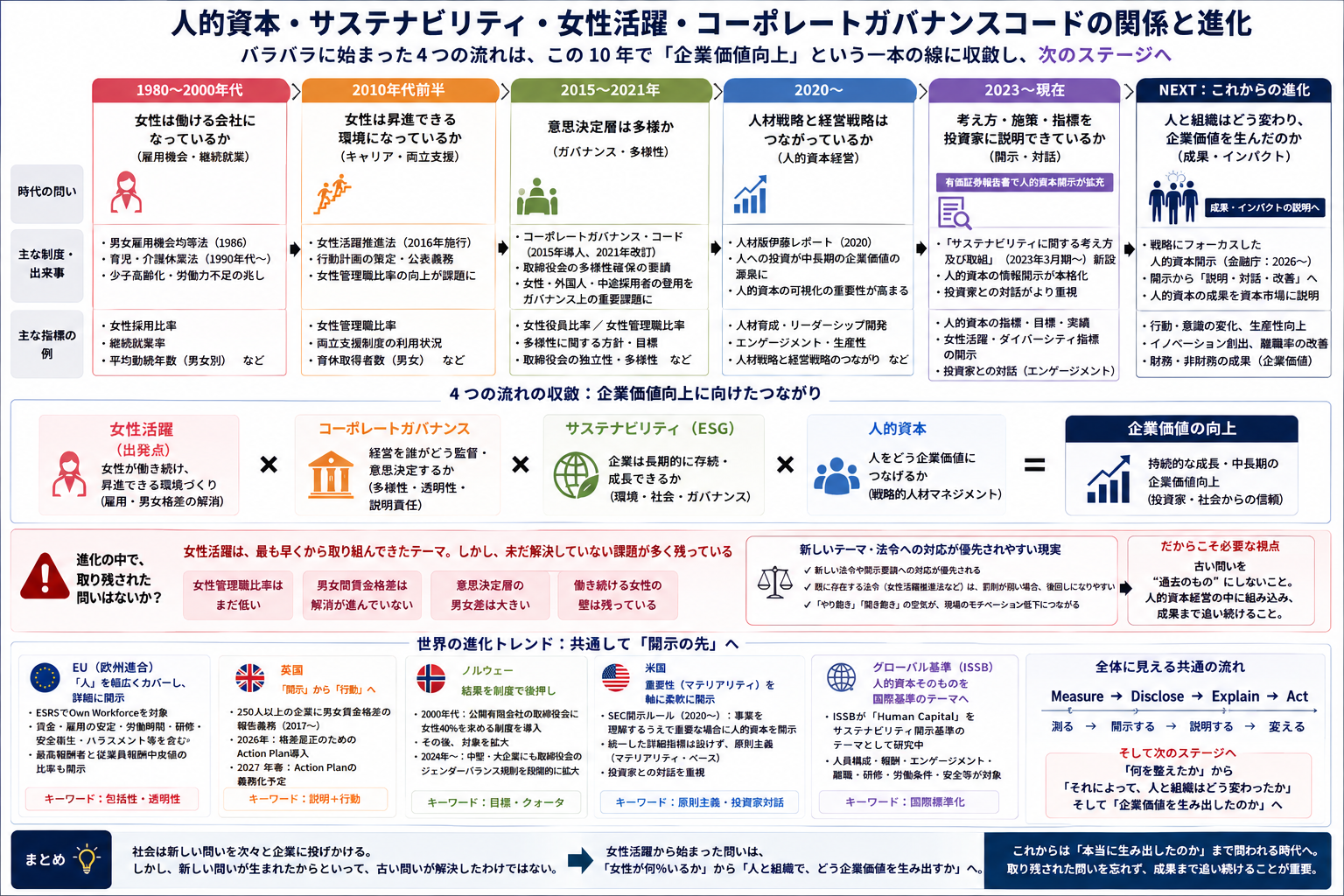
    そこで今回は少し視点を広げ、人的資本、サステナビリティ、女性活躍、コーポレートガバナンスという4つの流れを時系列に並べてみました。

    並べてみると、別々に進んできたように見える4つのテーマが、次第に**「企業は、人と組織の力を使ってどのように持続的な企業価値を生み出すのか」**という一つの問いに近づいているように見えます。

    社会から企業への問いは変化してきた

    女性活躍では、当初、

    「女性が働き続けられるか」
    「女性が昇進できるか」

    という問いが中心でした。

    コーポレートガバナンス改革が進むと、

    「意思決定をする人たちは多様か」

    という問いが加わります。

    サステナビリティでは、

    「企業が長期的に成長し続けるために何が必要か」

    人的資本では、

    「人材戦略と経営戦略はつながっているか」

    そして現在は、

    「その考え方、施策、指標、実績を投資家やステークホルダーに説明できるか」

    というところまで、問いが広がってきました。

    世界でも「開示」の先へ

    海外でも進み方はさまざまです。

    EUでは、人に関するより幅広い情報の開示が進み、英国では男女間賃金格差を測り、開示し、その先の行動へつなげる動きがあります。

    取締役会のジェンダーバランスを制度面から促す国もあれば、投資家にとって重要な人的資本情報の開示を求める市場もあります。

    さらに、国際的なサステナビリティ開示の議論でもHuman Capitalは重要なテーマになっています。

    方向は一つではありませんが、大きな流れとして、

    Measure → Disclose → Explain → Act

    「測る」
    →「開示する」
    →「説明する」
    →「行動する」

    という進化が見えてきます。

    その先では、

    何を整備したのかではなく、
    その結果、人と組織はどう変わったのか。
    そして、それはどのような企業価値につながったのか。

    という問いが、より重要になるのではないかと考えています。

    進化の中で、取り残された問いはないか

    一方、この流れを並べてみると、もう一つ気になることがあります。

    新しい問いが生まれたからといって、以前の問いが解決したわけではありません。

    ・女性管理職比率。
    ・男女間賃金格差。
    ・意思決定層の男女差。
    ・働き続けられる環境。

    女性活躍は長く取り組まれてきたテーマだからこそ、「すでに取り組んでいるテーマ」と認識されやすいのかもしれません。

    しかし、

    「長く取り組んできた」ことと、
    「解決した」ことは違います。

    ガバナンス、サステナビリティ、人的資本へと企業を取り巻くテーマが進化していく中で、以前から存在する課題を置き去りにしないことも重要だと思います。

    「何をしたか」から「何が変わったか」へ

    ・研修を実施した。
    ・制度を作った。
    ・目標を設定した。

    そこで終わるのではなく、

    制度・施策
    ↓
    人の行動や意思決定
    ↓
    組織の変化
    ↓
    事業成果
    ↓
    企業価値

    まで追っていく。

    人的資本、サステナビリティ、女性活躍、コーポレートガバナンスを別々のテーマとして扱うのではなく、企業がどのような価値を生み出そうとしているのかという一つのストーリーとして見る。

    今回4つの流れを並べてみて、そんなつながりが見えてきました。

    第二層Observation Projectでは、引き続き有価証券報告書を読みながら企業の組織環境を観察すると同時に、その企業を取り巻く「第一層」の変化についても観察していきます。

    How Human Capital, Sustainability, Women’s Advancement and Corporate Governance Have Converged

    As I continue observing Layer 2 — the organizational environment — through the Annual Securities Reports of Japanese companies, I have also become increasingly interested in the external forces shaping those environments.

    This led me to step outside Layer 2 for a moment and place four developments on the same timeline: women’s advancement, corporate governance, sustainability, and human capital.

    Viewed together, these themes, which developed through different routes, appear to be converging around a common question:

    How does a company use the capabilities of its people and organization to create sustainable corporate value?

    The questions being asked of companies have evolved

    Women’s advancement initially centered on questions such as:

    Can women continue working?
    Can women advance into leadership?

    Corporate governance reform added another question:

    Are the people making important decisions sufficiently diverse?

    Sustainability broadened the perspective further:

    What does a company need in order to continue creating value over the long term?

    Human capital introduced a closer connection between people and strategy:

    Is human capital strategy connected to business strategy?

    And today, another question is becoming increasingly important:

    Can the company explain its thinking, actions, indicators and results to investors and other stakeholders?

    Moving beyond disclosure

    International developments differ by jurisdiction.

    The EU has expanded disclosure relating to people and sustainability. In the UK, gender pay gap reporting has increased visibility around disparities and the actions taken in response. Other countries have introduced mechanisms to promote gender balance at board level.

    Human capital information is also increasingly viewed through the lens of investor relevance, while Human Capital itself is becoming an important area of international sustainability disclosure research.

    Although these approaches differ, I see a broader progression:

    Measure → Disclose → Explain → Act

    First, measure.
    Then disclose.
    Then explain.
    And ultimately, act.

    The next question may go even further:

    Not simply what systems or initiatives were introduced, but what actually changed in people and organizations — and whether those changes contributed to corporate value.

    Are any questions being left behind?

    Looking at this evolution raised another question for me.

    When new questions emerge, do some of the older ones remain unresolved?

    The proportion of women in management.
    Gender pay gaps.
    Gender differences in decision-making positions.
    Whether people can continue working and progressing in their careers.

    Women’s advancement has been on the corporate agenda for a long time. Precisely because of that, it can easily be perceived as something companies are already addressing.

    But:

    Working on an issue for a long time
    is not the same as solving it.

    As companies respond to governance, sustainability, human capital and new disclosure requirements, it is important that longstanding issues do not quietly disappear from view.

    From “what we did” to “what changed”

    Training was provided.
    A new system was introduced.
    A target was established.

    The story should not necessarily end there.

    Policies and interventions
    ↓
    Changes in individual behaviour and decision-making
    ↓
    Changes in the organization
    ↓
    Business outcomes
    ↓
    Corporate value

    Rather than treating human capital, sustainability, women’s advancement and corporate governance as separate agendas, perhaps they can be understood as parts of a single story:

    How does this company intend to create value, and how do its people and organization make that possible?

    Putting these four developments on the same timeline helped me see that connection more clearly.

    Through the Layer 2 Observation Project, I will continue observing organizational environments through Japanese companies’ Annual Securities Reports, while also looking at the Layer 1 changes surrounding those companies.

  • 第一層は、第二層をどう動かそうとしているのか

    第一層は、第二層をどう動かそうとしているのか

    第一層は、第二層をどう動かそうとしているのか

    Layer 2 Observation Projectでは、日本企業の有価証券報告書を読みながら、企業が整えようとしている第二層=組織・環境を観察しています。

    企業を観察していると、その企業を取り巻く社会や制度、つまり第一層にも目が向くようになりました。

    東京都の「女性活躍推進条例」を読んでいて、興味深いことがありました。

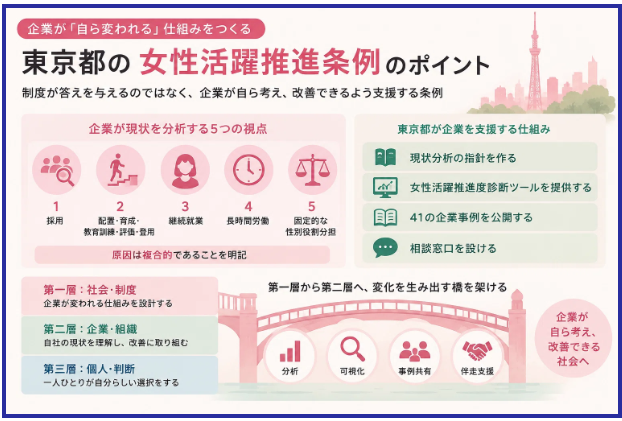
    この条例は、企業に「女性管理職を○%にしなさい」と一律の答えを与えるものではありません。

    むしろ東京都がつくろうとしているのは、

    企業が自ら現状を理解し、変わっていくための仕組み

    でした。

    企業自身に「分析」を求める

    条例では、企業が自社の状況を、

    • 採用
    • 配置・育成・教育訓練・評価・登用
    • 継続就業
    • 長時間労働
    • 固定的な性別役割分担

    という複数の視点から分析し、その結果を踏まえて取り組むことが示されています。

    また、女性活躍を阻む原因についても、一つの要因だけで説明するのではなく、複合的に捉えるという考え方が置かれています。

    制度だけでなく、企業が動くための環境をつくる

    さらに東京都は、企業に分析や改善を求めるだけではなく、

    現状を分析するための指針
    診断ツール
    企業事例
    相談・支援

    など、企業自身が取り組みを進めるための環境も整えています。

    ここが特に興味深いと感じました。

    第一層である社会・制度が、第二層である企業・組織に直接「こう変わりなさい」と答えを与えるのではない。

    企業が自ら分析し、可視化し、考え、改善できるように、その間に橋を架けている。

    そんな構造に見えます。

    3つの層で見る

    Women Impact Studioでは、人と組織を取り巻く構造を3つの層から観察しています。

    第一層:社会・制度
    企業を取り巻く法律、制度、社会からの要請。

    第二層:企業・組織
    企業がつくる制度、配置、育成、評価、組織環境。

    第三層:個人・判断
    その環境の中で、一人ひとりがどのように判断するのか。

    今回の条例をこの3層で見ると、第一層が第二層を動かすために、

    分析 → 可視化 → 事例共有 → 伴走支援

    という仕組みを設計していることが見えてきました。

    制度そのものを見るだけでなく、

    「第一層は、第二層をどう動かそうとしているのか」

    という視点で制度を見る。

    第二層Observation Projectを続けながら、企業を取り巻く第一層についても観察していきたいと思います。

    How Is Layer 1 Trying to Influence Layer 2?

    Through the Layer 2 Observation Project, I read the Annual Securities Reports of Japanese companies to observe Layer 2 — the organizational environment that companies are trying to create.

    As I continued observing companies, I became increasingly interested in what surrounds them: Layer 1 — society, policy and institutional systems.

    Tokyo’s ordinance promoting women’s advancement provided an interesting example.

    Rather than simply instructing companies to achieve a uniform percentage of women in management, the approach appears to focus on something different:

    creating mechanisms that enable companies to understand their own situation and improve it themselves.

    Asking companies to analyze their own organizations

    The framework encourages companies to examine their current situation from several perspectives, including:

    • recruitment
    • assignment, development, training, evaluation and promotion
    • continued employment
    • long working hours
    • fixed gender-role assumptions

    It also recognizes that barriers to women’s advancement do not necessarily have a single cause. They can arise from multiple, interconnected factors.

    Creating an environment in which companies can act

    The Tokyo Metropolitan Government does more than ask companies to analyze and improve.

    It also provides mechanisms to support that process, including:

    guidance for analyzing current conditions
    diagnostic tools
    examples from other companies
    consultation and support

    This is what I found particularly interesting.

    Layer 1 — society and institutions — is not simply telling Layer 2 — companies and organizations — exactly how to change.

    Instead, it appears to be building a bridge that helps companies analyze, visualize, think and improve for themselves.

    Looking through three layers

    Women Impact Studio observes people and organizations through three layers:

    Layer 1: Society and institutions
    Laws, policies, systems and expectations surrounding companies.

    Layer 2: Companies and organizations
    Organizational systems, development, assignment, evaluation and working environments.

    Layer 3: Individual decision-making
    How individuals make decisions within those environments.

    Viewed through this framework, Tokyo’s approach illustrates how Layer 1 can seek to influence Layer 2 through a sequence such as:

    Analyze → Visualize → Share examples → Support action

    Rather than looking only at what a policy requires, I am becoming interested in another question:

    How is Layer 1 designed to influence Layer 2?

    As the Layer 2 Observation Project continues, I will also observe the Layer 1 environment surrounding companies.

Legal Notice |