タグ: Human Capital

  • リクルートの人的資本を有価証券報告書から読む

    リクルートの人的資本を有価証券報告書から読む

    第二層観察プロジェクト #009

    リクルートの人的資本を有価証券報告書から読む

    人的資本経営が注目される中、企業は実際にどのような環境を整えようとしているのでしょうか。

    このシリーズでは、企業が正式に開示した有価証券報告書だけを読み、企業が整えようとしている**第2層(組織・環境)**を観察していきます。


    ① リクルートは何を目指しているのか

    リクルートは、ビジョンとして

    「Follow Your Heart」

    を掲げています。

    一人ひとりが自分に素直に、自分で決め、自分らしい人生を歩める社会を目指すという考え方です。

    また、バリューとして、

    • 新しい価値の創造
    • 個の尊重
    • 社会への貢献

    を掲げています。

    人的資本においても、従業員一人ひとりの意思や好奇心を起点に、新しい価値を生み出すことを重視しています。


    ② 女性育成の位置付け

    女性活躍は、経営戦略の一つである**「Prosper Together」**の中に位置付けられています。

    リクルートは、2031年3月期までに、グループ全体の

    • 従業員
    • 管理職
    • 上級管理職

    のそれぞれにおいて、ジェンダーパリティを目指しています。

    さらに、取締役・監査役についても、同じく2031年3月期までのジェンダーパリティを目標としています。

    女性管理職だけではなく、従業員から経営層、取締役会まで、組織の各層を対象としている点が特徴です。


    ③ 第二層の成熟度

    働く環境

    • オープン有給休暇制度
    • 在宅勤務環境の整備
    • 副業・兼業の推進
    • アルムナイ制度
    • 社外での自己実現を支える仕組み

    学ぶ環境

    • Indeedスキルアカデミー
    • Boost Apprenticeship Program
    • ITブートキャンプ
    • 役割変更時のトランジション研修
    • コーチングメソッドを取り入れた人材育成

    キャリア・配置

    • ミッショングレード制
    • Will-Can-Mustシート
    • キャリアウェブ
    • 新規事業提案制度「Ring」
    • グローバルメンター制度
    • ユニット経営

    マネジメント

    • 管理職要件の明文化
    • 人材開発委員会
    • サクセッションプラン
    • エンゲージメントサーベイ
    • ポストごとの職務要件・人材要件の設定

    ④ 私が立ち止まった一文

    「その一つである『管理職要件の明文化』では、女性と男性の両方の管理職候補者が増え、さまざまなバックグラウンドを持つリーダーが生まれる兆しが出てきています。」

    この一文に立ち止まりました。

    まず、「管理職とは何か」を明文化すること自体が、私にはとても新鮮でした。

    多くの組織では、管理職にふさわしい人がどのような人なのかは、明確に言葉にされていないことがあります。

    過去に管理職になった人のタイプや、上司が抱く漠然としたイメージによって、候補者が選ばれてしまうこともあるのではないでしょうか。

    管理職要件が明文化されると、候補者は、

    「自分には何があり、何がまだ足りないのか」

    を具体的に考えられるようになります。

    選ぶ側も、これまでの管理職像に似ているかどうかではなく、明文化された要件をもとに候補者を見ることができます。

    そして実際に、女性だけではなく、男性も含めて管理職候補者が増え、さまざまなバックグラウンドを持つリーダーが生まれる兆しが出ている。

    女性向けの特別な施策ではなく、管理職を選ぶ基準そのものを見直したことで、多様な候補者が見えるようになったという点が、とても素晴らしいと思いました。


    ⑤ 私の観察

    リクルートの有価証券報告書を読んで感じたのは、この会社は、女性本人に何かを身につけてもらう前に、組織が人を見る基準を変えようとしているということです。

    女性管理職が少ないとき、女性に研修を提供したり、意欲を高めたりする施策が考えられがちです。

    しかし、女性が変わっても、管理職に選ばれる人のイメージや基準が曖昧なままであれば、候補者として認識される人は変わらないかもしれません。

    リクルートは、「管理職とは何か」を言葉にしました。

    そのことで、これまで上司の頭の中にだけあった基準が、候補者にも組織にも見えるようになります。

    結果として、女性と男性の双方で管理職候補者が増え、多様なバックグラウンドを持つリーダーが生まれる兆しが出ています。

    これは、女性にだけ働きかける施策ではありません。

    管理職候補を見いだす組織側の判断基準を変える取り組みです。

    リクルートでは、Will-Can-Mustシートやキャリアウェブなど、本人の意思を見えるようにする仕組みも整えられています。

    そこに、管理職要件の明文化によって、組織側の期待も見えるようになる。

    本人の意思と、組織が求めるものの両方を言葉にすることで、これまで見えなかった候補者が見えるようになる。

    そこに、リクルートの第2層の特徴があると感じました。


    ⑥ 第二層の思想

    リクルートは、「人は、本人の意思と組織の期待が言葉になり、次の機会が見えることで成長する」と考えているように見えました。

    本人が何をしたいのかを言葉にする。

    管理職に何が求められるのかを言葉にする。

    そして、挑戦できる機会を開く。

    リクルートは、曖昧だったものを明文化することで、人の可能性を見つけやすくしようとしているように感じました。


    ⑦ 法定開示指標(2025年度有価証券報告書)

    指標数値
    女性管理職比率(株式会社リクルート)35.0%
    上級管理職女性比率(株式会社リクルート)33.3%
    提出会社単体の女性管理職比率今回確認した範囲では未確認
    男性育児休業取得率今回確認した範囲では未確認
    男女賃金差異今回確認した範囲では未確認

    ※リクルートホールディングスは純粋持株会社であるため、有価証券報告書では、主要子会社である株式会社リクルートの数値が中心に開示されています。


    Women Impact Studioでは、第2層(組織・環境)と第3層(個人の判断)の両方を観察しています。第3層の見える化には、RUMIOSを用いています。

    Layer 2 Observation Project #009

    Reading Recruit’s Human Capital Strategy Through Its Annual Securities Report

    As human capital management gains increasing attention, how are companies actually designing the organizational environment?

    In this series, I observe what I call Layer 2 (the organizational environment) by reading only the officially filed Annual Securities Reports of Japanese companies.


    ① Recruit’s Vision

    Recruit’s vision is:

    “Follow Your Heart.”

    It reflects the aspiration to create a society where each person can be true to themselves, make their own choices, and pursue a life that is right for them.

    Recruit also defines three core values:

    • Wow the World
    • Bet on Passion
    • Prioritize Social Value

    In its approach to human capital, Recruit emphasizes creating new value by starting with each employee’s own aspirations and curiosity.


    ② Positioning of Women’s Development

    Women’s advancement is positioned within “Prosper Together,” one of Recruit’s strategic commitments.

    By FY2030, Recruit aims to achieve gender parity across the Group among:

    • Employees
    • Management
    • Senior leadership

    It also aims to achieve gender parity among directors and Audit & Supervisory Board members by FY2030.

    What stands out is that the ambition extends beyond women in management to multiple levels of the organization—from employees through senior leadership and the board.


    ③ Layer 2 Design

    Work Environment

    • Open paid leave
    • Remote work environment
    • Support for side jobs and outside activities
    • Alumni programs
    • Systems supporting personal aspirations outside the company

    Learning Environment

    • Indeed Skills Academy
    • Boost Apprenticeship Program
    • IT boot camps
    • Transition training when changing roles
    • People development incorporating coaching methods

    Career and Talent Deployment

    • Mission Grade system
    • Will-Can-Must sheet
    • Career Web
    • “Ring” new business proposal program
    • Global mentoring program
    • Unit management

    Management

    • Clearly defined management requirements
    • Talent Development Committee
    • Succession planning
    • Engagement surveys
    • Role and talent requirements defined for individual positions

    ④ A Phrase that Caught My Eye

    “Through one of these initiatives—clarifying management requirements—the number of both female and male management candidates has increased, and signs are emerging of leaders from a wider variety of backgrounds.”

    This phrase caught my eye.

    The idea of explicitly defining what it means to be a manager itself felt striking to me.

    In many organizations, what makes someone suitable for management is not always clearly articulated.

    Candidates may instead be identified based on the types of people who became managers in the past, or on an individual manager’s implicit image of what a leader should look like.

    When management requirements are made explicit, candidates can ask:

    “What strengths do I already have, and what do I still need to develop?”

    Those selecting candidates can also assess people against clearly stated requirements rather than whether they resemble previous managers.

    And Recruit reports that both female and male management candidates have increased, with signs of leaders emerging from more diverse backgrounds.

    What I found particularly interesting is that this is not a special initiative designed only for women.

    By changing the criteria used to identify managers, Recruit appears to have made a wider range of candidates visible.


    ⑤ My Observation

    What struck me in Recruit’s Annual Securities Report is that, before asking women themselves to change, the company appears to be changing how the organization evaluates people.

    When women are underrepresented in management, organizations often introduce training programs or initiatives designed to increase women’s motivation.

    But even if women change, if the image of “management potential” remains vague, the people recognized as potential candidates may remain the same.

    Recruit made the requirements for management explicit.

    This makes criteria that may previously have existed only in a manager’s mind visible to both candidates and the organization.

    And the result appears to be an increase in both female and male management candidates, with leaders emerging from more diverse backgrounds.

    This is not an intervention aimed only at women.

    It is an effort to change the organization’s criteria for identifying management potential.

    Recruit also has mechanisms such as the Will-Can-Must sheet and Career Web that make employees’ own aspirations visible.

    Management requirements, in turn, make the organization’s expectations visible.

    By putting both the individual’s aspirations and the organization’s expectations into words, candidates who may previously have gone unnoticed can become visible.

    That, to me, is a distinctive feature of Recruit’s Layer 2.


    ⑥ The Thinking Behind Layer 2

    Recruit appears to believe that people thrive when both their own aspirations and the organization’s expectations are put into words, making the next opportunity visible.

    Put into words what an individual wants to do.

    Put into words what is expected of a manager.

    Then open opportunities to take on new challenges.

    By making what was previously implicit explicit, Recruit appears to be making people’s potential easier to recognize.


    ⑦ Statutory Disclosure Indicators

    FY2025 Annual Securities Report

    IndicatorFigure
    Women in management (Recruit Co., Ltd.)35.0%
    Women in senior management (Recruit Co., Ltd.)33.3%
    Women in management at the reporting companyNot confirmed in the sections reviewed
    Men taking childcare leaveNot confirmed in the sections reviewed
    Gender pay gapNot confirmed in the sections reviewed

    Recruit Holdings is a pure holding company, so the Annual Securities Report primarily discloses figures for its major subsidiary, Recruit Co., Ltd.


    At Women Impact Studio, we observe both Layer 2 (organizational environment) and Layer 3 (individual decision-making). We use RUMIOS to make Layer 3 visible.
  • KDDIの人的資本を有価証券報告書から読む

    KDDIの人的資本を有価証券報告書から読む

    第二層観察プロジェクト #008

    KDDIの人的資本を有価証券報告書から読む

    人的資本経営が注目される中、企業は実際にどのような環境を整えようとしているのでしょうか。

    このシリーズでは、企業が正式に開示した有価証券報告書だけを読み、企業が整えようとしている**第2層(組織・環境)**を観察していきます。


    ① KDDIは何を目指しているのか

    KDDIは、企業理念として、

    「全従業員の物心両面の幸福を追求すると同時に、お客さまの期待を超える感動をお届けすることにより、豊かなコミュニケーション社会の発展に貢献する」

    ことを掲げています。

    「KDDI VISION 2030」では、

    「『つなぐチカラ』を進化させ、誰もが思いを実現できる社会をつくる」

    ことを目指しています。

    人的資本戦略では、

    • ジョブ型の進化
    • DE&Iの深化
    • 働き方のアップデート

    を3本柱とし、多様なスキルや経験を組織の力につなげようとしています。


    ② 女性育成の位置付け

    女性活躍は、人的資本戦略の3本柱の一つである**「DE&Iの深化」**の中に位置付けられています。

    KDDIは、2040年までに、KDDIグループ連結における女性経営基幹職比率を、女性の在籍比率と同じ水準にすることを目標に掲げています。

    有価証券報告書では、経営基幹職を、

    「組織のリーダーならびに専門領域のエキスパート」

    と定義しています。

    つまり、部下を持つ管理職だけでなく、高度な専門性を持つエキスパート職も、上位キャリアとして含まれています。

    また、全社一律の登用目標だけではなく、管掌部門ごとに、採用から経営幹部候補の登用まで、各段階の課題とプロセス目標を設定する方針へ転換しています。

    サステナビリティの達成度は、役員報酬だけでなく、全社員の賞与にも連動しています。


    ③ 第二層の成熟度

    働く環境

    • 健康経営の推進
    • 長時間労働の削減
    • 新本社における健康を支える環境整備
    • KDDIグループ健康経営宣言

    学ぶ環境

    • KDDI版ジョブ型人事制度
    • 30の専門領域と必要な役割・スキルを示す「ジョブ図鑑」
    • 全社員を対象としたDX基礎スキル研修
    • DX・生成AIを学ぶ長期インターンシップ

    キャリア・配置

    • 社内公募制度
    • 社内フリーエージェント制度
    • プロ人財の認定
    • 認定されたプロ人財の全社公開
    • HRダッシュボード「マネジメントインサイト」
    • AIを活用した評価フィードバック支援

    マネジメント

    • DE&I推進会議
    • 管掌部門ごとの人材パイプライン管理
    • 社内外イベントにおける「パネルガイドライン」
    • エンゲージメントスコアの継続的なモニタリング

    ④ 私が立ち止まった一文

    「社内イベントでの多様性確保のため『パネルガイドライン』を新設し、登壇者に女性または39歳以下を1名以上、あるいは全体の25%以上を目安として義務化しました。」

    この一文に立ち止まりました。

    私たちが日常的に目にする景色は、とても重要だと思っています。

    例えば、学校に歴代校長の写真が飾られ、そこに男性の写真しかなければ、子どもたちは意識しないまま、

    「校長先生になるのは男性なのだ」

    「女性は校長先生にはならないのだ」

    と受け取るかもしれません。

    誰かに言葉で教えられなくても、繰り返し目にする景色は、**「誰がその場所に立つ人なのか」**という無意識の前提をつくります。

    KDDIのパネルガイドラインは、社内イベントの登壇者に多様性を持たせることを、努力目標ではなく義務にしています。

    女性や若い世代が前に立つ景色を意図的に増やす。

    組織の中で見える景色を変えることによって、アンコンシャスバイアスにも働きかけようとしている点が、とても印象に残りました。


    ⑤ 私の観察

    KDDIの有価証券報告書を読んで感じたのは、この会社は、能力を育てるだけでなく、人が見ることのできる可能性そのものを増やそうとしているということです。

    ジョブ図鑑によって、必要な専門性とキャリアの方向を見えるようにする。

    認定されたプロ人財を社内で公開し、専門性を持って活躍する人を見えるようにする。

    経営基幹職に、組織のリーダーだけでなく、専門領域のエキスパートも含める。

    そして、パネルガイドラインによって、女性や若い世代が前に立つ景色を増やす。

    従来、女性活躍は「部下を持つ女性管理職を増やす」という一本の道で語られがちでした。

    しかしKDDIでは、マネジメントだけではない上位キャリアも示されています。

    女性が進める道を、管理職という一つの形に限定しない。

    これは、女性経営基幹職比率を高めるという目標の中にも表れているように感じました。

    現在、女性社員比率と女性取締役比率は約25%である一方、女性経営基幹職比率は18.0%です。

    KDDIは、この差を単に数値目標で埋めようとしているのではありません。

    誰が前に立てるのか。

    どのような形で上位キャリアへ進めるのか。

    その両方を、組織の中で見えるようにしようとしている。

    KDDIの第2層には、見える景色を変えることと、見えるキャリアの形を増やすことの両方が組み込まれているように感じました。


    ⑥ 第二層の思想

    KDDIは、「人は、自分が進めるキャリアと、そこで活躍する人の姿が見えることで、次の一歩を選べる」と考えているように見えました。

    必要なスキルを可視化する。

    専門性を持って活躍する人を可視化する。

    女性や若い世代が前に立つ姿を可視化する。

    KDDIは、「見えるようにすること」によって、個人の選択と組織の無意識の前提の両方を変えようとしているように感じました。


    ⑦ 法定開示指標(2025年度有価証券報告書)

    指標数値
    女性経営基幹職比率(KDDI単体・STEM領域を除く)18.0%
    女性取締役比率25.0%
    男性育児休業取得率今回確認した範囲では未確認
    男女賃金差異今回確認した範囲では未確認

    ※経営基幹職は、「組織のリーダーならびに専門領域のエキスパート」と定義されています。


    Women Impact Studioでは、第2層(組織・環境)と第3層(個人の判断)の両方を観察しています。第3層の見える化には、RUMIOSを用いています。

    Layer 2 Observation Project #008

    Reading KDDI’s Human Capital Strategy Through Its Annual Securities Report

    As human capital management gains increasing attention, how are companies actually designing the organizational environment?

    In this series, I observe what I call Layer 2 (the organizational environment) by reading only the officially filed Annual Securities Reports of Japanese companies.


    ① KDDI’s Vision

    KDDI’s corporate philosophy is to:

    “Pursue the material and intellectual growth of all employees while contributing to the advancement of a rich communications society by delivering experiences that exceed customer expectations.”

    Under KDDI VISION 2030, the company aims to:

    “Evolve the power to connect and create a society where everyone can make their aspirations a reality.”

    Its human capital strategy is built around three pillars:

    • Evolution of its job-based HR system
    • Deepening DE&I
    • Updating ways of working

    Through these pillars, KDDI seeks to turn diverse skills and experiences into organizational strength.


    ② Positioning of Women’s Development

    Women’s advancement is positioned within “Deepening DE&I,” one of the three pillars of KDDI’s human capital strategy.

    By 2040, KDDI aims to bring the proportion of women in key management positions across the consolidated KDDI Group to the same level as the proportion of women in its workforce.

    The Annual Securities Report defines these key management positions as:

    “organizational leaders and experts in specialized fields.”

    This means that senior career paths are not limited to managers with direct reports. Highly skilled experts are also included.

    KDDI has also shifted from relying solely on company-wide promotion targets to setting challenges and process targets within each business division, covering each stage of the pipeline from recruitment through the development of executive candidates.

    Sustainability performance is linked not only to executive compensation, but also to bonuses for all employees.


    ③ Layer 2 Design

    Work Environment

    • Health management initiatives
    • Reduction of long working hours
    • Health-supportive environment at the new headquarters
    • KDDI Group Health Management Declaration

    Learning Environment

    • KDDI’s job-based HR system
    • “Job Encyclopedia,” defining roles and skills across 30 professional fields
    • Basic DX skills training for all employees
    • Long-term internships focused on DX and generative AI

    Career and Talent Deployment

    • Internal job posting system
    • Internal free-agent system
    • Professional talent certification
    • Company-wide visibility of certified professional talent
    • HR dashboard “Management Insight”
    • AI-supported performance feedback

    Management

    • DE&I Promotion Council
    • Talent pipeline management by business division
    • “Panel Guidelines” for internal and external events
    • Continuous monitoring of employee engagement

    ④ A Phrase that Caught My Eye

    “To ensure diversity at internal events, we introduced Panel Guidelines requiring speakers to include at least one woman or person aged 39 or younger, or for such speakers to account for at least 25% of the panel.”

    This phrase caught my eye.

    I believe the scenery we repeatedly see matters.

    Imagine a school displaying photographs of all its former principals—and every photograph is of a man.

    Without anyone explicitly telling them, children may begin to assume:

    “Principals are men.”

    “Women don’t become principals.”

    What we repeatedly see can create unconscious assumptions about who belongs in certain positions.

    KDDI’s Panel Guidelines do not treat diversity among speakers simply as an aspiration. They make it a requirement.

    By deliberately increasing the visibility of women and younger people at the front of the room, KDDI appears to be trying to influence unconscious bias by changing what people repeatedly see inside the organization.


    ⑤ My Observation

    What struck me in KDDI’s Annual Securities Report is that the company appears to be doing more than developing people’s capabilities.

    It is also trying to expand the possibilities people can see.

    The Job Encyclopedia makes required expertise and career directions visible.

    Certified professional talent is shared across the company, making people who succeed through expertise visible.

    Key management positions include not only organizational leaders, but also experts in specialized fields.

    And the Panel Guidelines increase the visibility of women and younger generations at the front of the room.

    Women’s advancement has often been discussed as a single path: increasing the number of women who become people managers.

    KDDI presents another senior career path based on expertise.

    It does not appear to limit women’s advancement to one definition of management.

    Today, women represent approximately 25% of employees and 25% of directors, while women account for 18.0% of key management positions.

    KDDI does not appear to be trying to close this gap through numerical targets alone.

    Who can be seen at the front?

    What kinds of senior career paths can people see themselves pursuing?

    KDDI appears to be making both more visible.

    Its Layer 2 design seems to combine changing the scenery people see with expanding the career paths they can see.


    ⑥ The Thinking Behind Layer 2

    KDDI appears to believe that people thrive when they can see both the career paths available to them and people like themselves succeeding along those paths.

    Make required skills visible.

    Make people succeeding through expertise visible.

    Make women and younger generations visible at the front of the room.

    Through this emphasis on visibility, KDDI appears to be trying to influence both individual choices and the organization’s unconscious assumptions.


    ⑦ Statutory Disclosure Indicators

    FY2025 Annual Securities Report

    IndicatorFigure
    Women in key management positions (KDDI standalone, excluding STEM areas)18.0%
    Women directors25.0%
    Men taking childcare leaveNot confirmed in the sections reviewed
    Gender pay gapNot confirmed in the sections reviewed

    Key management positions are defined as “organizational leaders and experts in specialized fields.”


    At Women Impact Studio, we observe both Layer 2 (organizational environment) and Layer 3 (individual decision-making). We use RUMIOS to make Layer 3 visible.


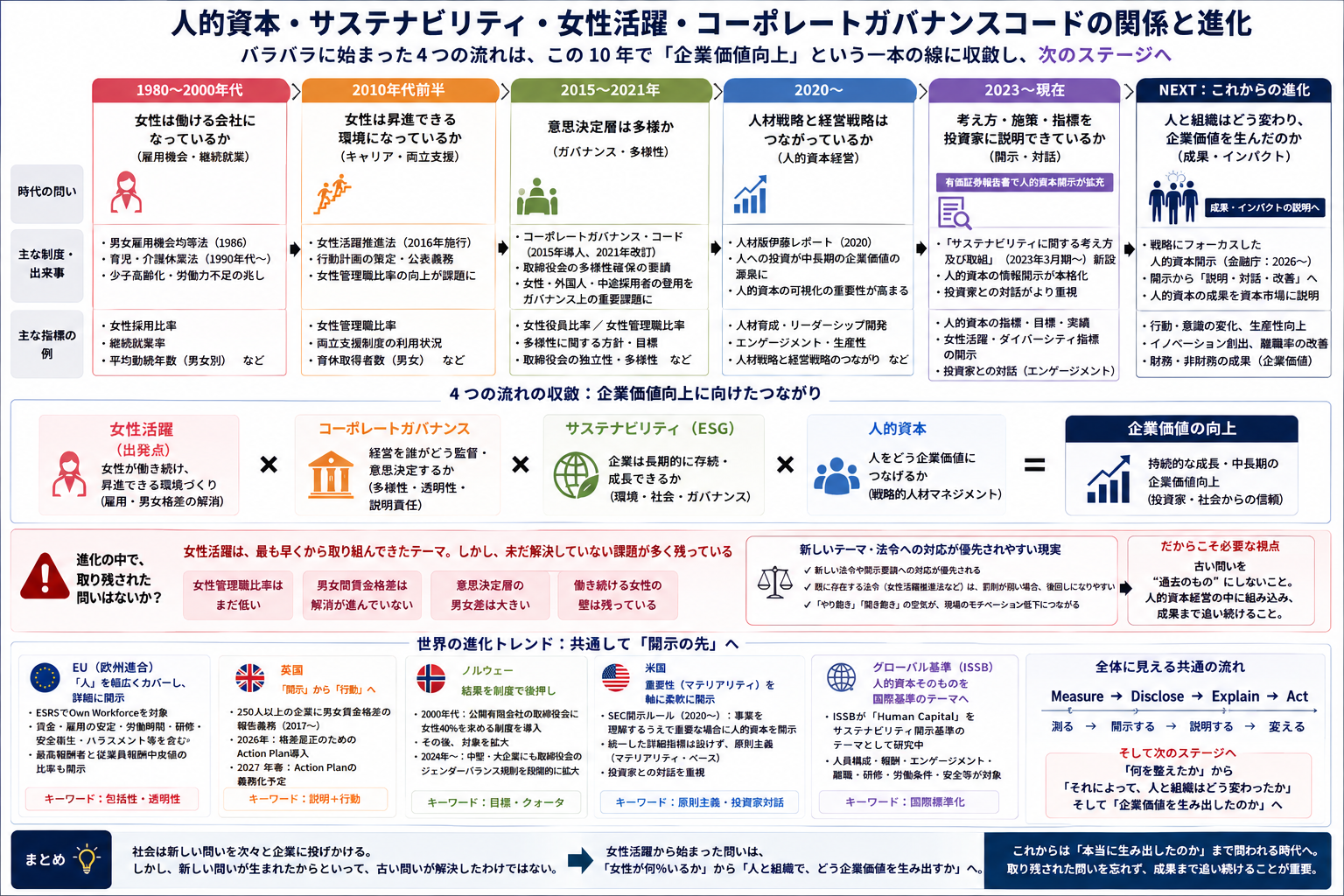
  • 人的資本・サステナビリティ・女性活躍・コーポレートガバナンスは、どうつながってきたのか

    人的資本・サステナビリティ・女性活躍・コーポレートガバナンスは、どうつながってきたのか

    日本語(English follows below)

    人的資本・サステナビリティ・女性活躍・コーポレートガバナンスは、どうつながってきたのか

    有価証券報告書を読みながら企業の「第二層=組織環境」を観察していると、その外側にある制度や社会からの要請も、企業の人材戦略に大きく影響していることが見えてきます。

    そこで今回は少し視点を広げ、人的資本、サステナビリティ、女性活躍、コーポレートガバナンスという4つの流れを時系列に並べてみました。

    並べてみると、別々に進んできたように見える4つのテーマが、次第に**「企業は、人と組織の力を使ってどのように持続的な企業価値を生み出すのか」**という一つの問いに近づいているように見えます。

    社会から企業への問いは変化してきた

    女性活躍では、当初、

    「女性が働き続けられるか」
    「女性が昇進できるか」

    という問いが中心でした。

    コーポレートガバナンス改革が進むと、

    「意思決定をする人たちは多様か」

    という問いが加わります。

    サステナビリティでは、

    「企業が長期的に成長し続けるために何が必要か」

    人的資本では、

    「人材戦略と経営戦略はつながっているか」

    そして現在は、

    「その考え方、施策、指標、実績を投資家やステークホルダーに説明できるか」

    というところまで、問いが広がってきました。

    世界でも「開示」の先へ

    海外でも進み方はさまざまです。

    EUでは、人に関するより幅広い情報の開示が進み、英国では男女間賃金格差を測り、開示し、その先の行動へつなげる動きがあります。

    取締役会のジェンダーバランスを制度面から促す国もあれば、投資家にとって重要な人的資本情報の開示を求める市場もあります。

    さらに、国際的なサステナビリティ開示の議論でもHuman Capitalは重要なテーマになっています。

    方向は一つではありませんが、大きな流れとして、

    Measure → Disclose → Explain → Act

    「測る」
    →「開示する」
    →「説明する」
    →「行動する」

    という進化が見えてきます。

    その先では、

    何を整備したのかではなく、
    その結果、人と組織はどう変わったのか。
    そして、それはどのような企業価値につながったのか。

    という問いが、より重要になるのではないかと考えています。

    進化の中で、取り残された問いはないか

    一方、この流れを並べてみると、もう一つ気になることがあります。

    新しい問いが生まれたからといって、以前の問いが解決したわけではありません。

    ・女性管理職比率。
    ・男女間賃金格差。
    ・意思決定層の男女差。
    ・働き続けられる環境。

    女性活躍は長く取り組まれてきたテーマだからこそ、「すでに取り組んでいるテーマ」と認識されやすいのかもしれません。

    しかし、

    「長く取り組んできた」ことと、
    「解決した」ことは違います。

    ガバナンス、サステナビリティ、人的資本へと企業を取り巻くテーマが進化していく中で、以前から存在する課題を置き去りにしないことも重要だと思います。

    「何をしたか」から「何が変わったか」へ

    ・研修を実施した。
    ・制度を作った。
    ・目標を設定した。

    そこで終わるのではなく、

    制度・施策
    ↓
    人の行動や意思決定
    ↓
    組織の変化
    ↓
    事業成果
    ↓
    企業価値

    まで追っていく。

    人的資本、サステナビリティ、女性活躍、コーポレートガバナンスを別々のテーマとして扱うのではなく、企業がどのような価値を生み出そうとしているのかという一つのストーリーとして見る。

    今回4つの流れを並べてみて、そんなつながりが見えてきました。

    第二層Observation Projectでは、引き続き有価証券報告書を読みながら企業の組織環境を観察すると同時に、その企業を取り巻く「第一層」の変化についても観察していきます。

    How Human Capital, Sustainability, Women’s Advancement and Corporate Governance Have Converged

    As I continue observing Layer 2 — the organizational environment — through the Annual Securities Reports of Japanese companies, I have also become increasingly interested in the external forces shaping those environments.

    This led me to step outside Layer 2 for a moment and place four developments on the same timeline: women’s advancement, corporate governance, sustainability, and human capital.

    Viewed together, these themes, which developed through different routes, appear to be converging around a common question:

    How does a company use the capabilities of its people and organization to create sustainable corporate value?

    The questions being asked of companies have evolved

    Women’s advancement initially centered on questions such as:

    Can women continue working?
    Can women advance into leadership?

    Corporate governance reform added another question:

    Are the people making important decisions sufficiently diverse?

    Sustainability broadened the perspective further:

    What does a company need in order to continue creating value over the long term?

    Human capital introduced a closer connection between people and strategy:

    Is human capital strategy connected to business strategy?

    And today, another question is becoming increasingly important:

    Can the company explain its thinking, actions, indicators and results to investors and other stakeholders?

    Moving beyond disclosure

    International developments differ by jurisdiction.

    The EU has expanded disclosure relating to people and sustainability. In the UK, gender pay gap reporting has increased visibility around disparities and the actions taken in response. Other countries have introduced mechanisms to promote gender balance at board level.

    Human capital information is also increasingly viewed through the lens of investor relevance, while Human Capital itself is becoming an important area of international sustainability disclosure research.

    Although these approaches differ, I see a broader progression:

    Measure → Disclose → Explain → Act

    First, measure.
    Then disclose.
    Then explain.
    And ultimately, act.

    The next question may go even further:

    Not simply what systems or initiatives were introduced, but what actually changed in people and organizations — and whether those changes contributed to corporate value.

    Are any questions being left behind?

    Looking at this evolution raised another question for me.

    When new questions emerge, do some of the older ones remain unresolved?

    The proportion of women in management.
    Gender pay gaps.
    Gender differences in decision-making positions.
    Whether people can continue working and progressing in their careers.

    Women’s advancement has been on the corporate agenda for a long time. Precisely because of that, it can easily be perceived as something companies are already addressing.

    But:

    Working on an issue for a long time
    is not the same as solving it.

    As companies respond to governance, sustainability, human capital and new disclosure requirements, it is important that longstanding issues do not quietly disappear from view.

    From “what we did” to “what changed”

    Training was provided.
    A new system was introduced.
    A target was established.

    The story should not necessarily end there.

    Policies and interventions
    ↓
    Changes in individual behaviour and decision-making
    ↓
    Changes in the organization
    ↓
    Business outcomes
    ↓
    Corporate value

    Rather than treating human capital, sustainability, women’s advancement and corporate governance as separate agendas, perhaps they can be understood as parts of a single story:

    How does this company intend to create value, and how do its people and organization make that possible?

    Putting these four developments on the same timeline helped me see that connection more clearly.

    Through the Layer 2 Observation Project, I will continue observing organizational environments through Japanese companies’ Annual Securities Reports, while also looking at the Layer 1 changes surrounding those companies.

  • アステラス製薬の人的資本を有価証券報告書から読む

    アステラス製薬の人的資本を有価証券報告書から読む

    第二層観察プロジェクト #007

    アステラス製薬の人的資本を有価証券報告書から読む

    人的資本経営が注目される中、企業は実際にどのような環境を整えようとしているのでしょうか。

    このシリーズでは、企業が正式に開示した有価証券報告書だけを読み、企業が整えようとしている**第2層(組織・環境)**を観察していきます。


    ① アステラス製薬は何を目指しているのか

    アステラス製薬は、**「先端・信頼の医薬で、世界の人々の健康に貢献する」**を存在意義に掲げています。

    人的資本では、**「イノベーション実現のための人材と組織文化」**を重要課題とし、グローバルでの人材配置や組織力の強化を目指しています。


    ② 女性育成の位置付け

    女性活躍は、**「グローバルな人材・組織を支える人事制度の構築及び多様性の確保」**の一つとして位置付けられています。

    また、有価証券報告書には、

    「日本では、女性の活躍推進を優先度の高い課題と位置づけ、取り組んでいます。」

    と明記されていました。


    ③ 第二層の成熟度

    働く環境

    • My Workplace制度
    • 副業制度
    • 健康経営

    学ぶ環境

    • Next Generation Leadershipプログラム

    キャリア・配置

    • グローバル共通ジョブポスティング
    • グローバルアサインメント
    • サクセッションプランニング

    マネジメント

    • Ask Me Anything
    • 心理的安全性の醸成
    • フラットな組織づくり
    • エンゲージメントサーベイ

    ④ 私が立ち止まった一文

    「日本では、女性の活躍推進を優先度の高い課題と位置づけ、取り組んでいます。」

    この一文に立ち止まりました。

    「優先度の高い課題」と書かれている一方で、その後に続く具体的な取り組みについては、他社と比べると比較的簡潔な記載にとどまっているように感じました。


    ⑤ 私の観察

    これまで読んできた企業では、「女性活躍」や「人材育成」が重要課題として掲げられている場合、その背景となる考え方や育成施策まで比較的詳しく開示されているケースが多くありました。

    一方、アステラス製薬では、制度や仕組みは紹介されているものの、**「どのような人材を育てたいのか」「人はどのように成長すると考えているのか」**という考え方については、私には読み取りにくく感じました。

    だから今回印象に残ったのは、「何が書かれているか」だけではありません。

    何があまり語られていないか。

    という点にも、その企業らしさが表れるのかもしれないと思いました。

    100社を比較していくと、開示の濃淡そのものも、一つの観察対象になりそうです。


    ⑥ 第二層の思想

    アステラス製薬は、「人はグローバルな環境で最適に配置されることで力を発揮する」と考えているように見えました。

    一方で、その環境の中で人がどのように成長するのかという考え方については、有価証券報告書だけからは十分に読み取ることができませんでした。

    この点も、今後ほかの企業と比較していきたい観察ポイントです。


    ⑦ 法定開示指標(2025年度有価証券報告書)

    指標数値
    女性管理職比率(経営基幹職)19.7%
    男性育児休業等取得率72.7%(育休のみ55.5%)
    男女賃金差異(全労働者)76.9%
    男女賃金差異(正規雇用)77.5%
    男女賃金差異(パート・有期雇用)59.6%

    Women Impact Studioでは、第2層(組織・環境)と第3層(個人の判断)の両方を観察しています。第3層の見える化には、RUMIOSを用いています。

    Layer 2 Observation Project #007

    Reading Astellas Pharma’s Human Capital Strategy Through Its Annual Securities Report

    As human capital management gains increasing attention, how are companies actually designing their organizational environments?

    In this series, I observe what I call Layer 2 (the organizational environment) by reading only the officially filed Annual Securities Reports of Japanese companies.


    ① Astellas Pharma’s Vision

    Astellas Pharma defines its raison d’être as:

    “Contribute toward improving the health of people around the world through the provision of innovative and reliable pharmaceutical products.”

    Within human capital, Astellas identifies “People and Organizational Culture for Innovation” as an important priority, with an emphasis on global talent deployment and strengthening organizational capabilities.


    ② Positioning of Women’s Development

    Women’s advancement is positioned as part of building HR systems and ensuring diversity to support a global workforce and organization.

    The Annual Securities Report also states:

    “In Japan, we position the advancement of women as a high-priority issue and are taking steps to address it.”


    ③ Layer 2 Design

    Work Environment

    • My Workplace
    • Side-job program
    • Health and well-being initiatives

    Learning Environment

    • Next Generation Leadership program

    Career and Talent Deployment

    • Global job posting system
    • Global assignments
    • Succession planning

    Management

    • Ask Me Anything
    • Psychological safety initiatives
    • Building a flatter organization
    • Engagement surveys

    ④ A Phrase that Caught My Eye

    “In Japan, we position the advancement of women as a high-priority issue and are taking steps to address it.”

    This phrase caught my eye.

    While women’s advancement is explicitly described as a “high-priority issue,” the specific initiatives that follow are described relatively briefly compared with some of the other companies I have reviewed.


    ⑤ My Observation

    Among the companies I have reviewed so far, when women’s advancement or talent development is identified as an important issue, the Annual Securities Report often provides relatively detailed descriptions of both the underlying thinking and the initiatives designed to develop talent.

    At Astellas Pharma, systems and mechanisms are described, but I found it more difficult to identify the company’s underlying view of what kind of people it seeks to develop or how it believes people grow.

    What stood out to me, therefore, was not only what is disclosed.

    It was also:

    what is not discussed in much depth.

    Perhaps this, too, can reveal something about how a company thinks about human capital.

    As I continue comparing 100 companies, the depth and emphasis of disclosure itself may become an interesting observation point.


    ⑥ The Thinking Behind Layer 2

    Astellas Pharma appears to believe that people thrive when they are optimally deployed within a global environment.

    At the same time, I found it difficult to fully understand, from the Annual Securities Report alone, how the company believes people develop within that environment.

    This is another point I would like to continue observing as I compare companies.


    ⑦ Statutory Disclosure Indicators

    FY2025 Annual Securities Report

    IndicatorFigure
    Women in management (management-track positions)19.7%
    Men taking childcare-related leave72.7% (childcare leave only: 55.5%)
    Gender pay gap — all employees76.9%
    Gender pay gap — regular employees77.5%
    Gender pay gap — part-time and fixed-term employees59.6%

    At Women Impact Studio, we observe both Layer 2 (organizational environment) and Layer 3 (individual decision-making). We use RUMIOS to make Layer 3 visible.


  • 第一層は、第二層をどう動かそうとしているのか

    第一層は、第二層をどう動かそうとしているのか

    第一層は、第二層をどう動かそうとしているのか

    Layer 2 Observation Projectでは、日本企業の有価証券報告書を読みながら、企業が整えようとしている第二層=組織・環境を観察しています。

    企業を観察していると、その企業を取り巻く社会や制度、つまり第一層にも目が向くようになりました。

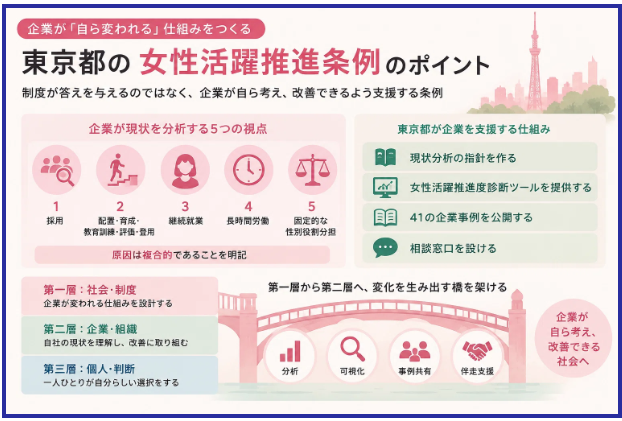
    東京都の「女性活躍推進条例」を読んでいて、興味深いことがありました。

    この条例は、企業に「女性管理職を○%にしなさい」と一律の答えを与えるものではありません。

    むしろ東京都がつくろうとしているのは、

    企業が自ら現状を理解し、変わっていくための仕組み

    でした。

    企業自身に「分析」を求める

    条例では、企業が自社の状況を、

    • 採用
    • 配置・育成・教育訓練・評価・登用
    • 継続就業
    • 長時間労働
    • 固定的な性別役割分担

    という複数の視点から分析し、その結果を踏まえて取り組むことが示されています。

    また、女性活躍を阻む原因についても、一つの要因だけで説明するのではなく、複合的に捉えるという考え方が置かれています。

    制度だけでなく、企業が動くための環境をつくる

    さらに東京都は、企業に分析や改善を求めるだけではなく、

    現状を分析するための指針
    診断ツール
    企業事例
    相談・支援

    など、企業自身が取り組みを進めるための環境も整えています。

    ここが特に興味深いと感じました。

    第一層である社会・制度が、第二層である企業・組織に直接「こう変わりなさい」と答えを与えるのではない。

    企業が自ら分析し、可視化し、考え、改善できるように、その間に橋を架けている。

    そんな構造に見えます。

    3つの層で見る

    Women Impact Studioでは、人と組織を取り巻く構造を3つの層から観察しています。

    第一層:社会・制度
    企業を取り巻く法律、制度、社会からの要請。

    第二層:企業・組織
    企業がつくる制度、配置、育成、評価、組織環境。

    第三層:個人・判断
    その環境の中で、一人ひとりがどのように判断するのか。

    今回の条例をこの3層で見ると、第一層が第二層を動かすために、

    分析 → 可視化 → 事例共有 → 伴走支援

    という仕組みを設計していることが見えてきました。

    制度そのものを見るだけでなく、

    「第一層は、第二層をどう動かそうとしているのか」

    という視点で制度を見る。

    第二層Observation Projectを続けながら、企業を取り巻く第一層についても観察していきたいと思います。

    How Is Layer 1 Trying to Influence Layer 2?

    Through the Layer 2 Observation Project, I read the Annual Securities Reports of Japanese companies to observe Layer 2 — the organizational environment that companies are trying to create.

    As I continued observing companies, I became increasingly interested in what surrounds them: Layer 1 — society, policy and institutional systems.

    Tokyo’s ordinance promoting women’s advancement provided an interesting example.

    Rather than simply instructing companies to achieve a uniform percentage of women in management, the approach appears to focus on something different:

    creating mechanisms that enable companies to understand their own situation and improve it themselves.

    Asking companies to analyze their own organizations

    The framework encourages companies to examine their current situation from several perspectives, including:

    • recruitment
    • assignment, development, training, evaluation and promotion
    • continued employment
    • long working hours
    • fixed gender-role assumptions

    It also recognizes that barriers to women’s advancement do not necessarily have a single cause. They can arise from multiple, interconnected factors.

    Creating an environment in which companies can act

    The Tokyo Metropolitan Government does more than ask companies to analyze and improve.

    It also provides mechanisms to support that process, including:

    guidance for analyzing current conditions
    diagnostic tools
    examples from other companies
    consultation and support

    This is what I found particularly interesting.

    Layer 1 — society and institutions — is not simply telling Layer 2 — companies and organizations — exactly how to change.

    Instead, it appears to be building a bridge that helps companies analyze, visualize, think and improve for themselves.

    Looking through three layers

    Women Impact Studio observes people and organizations through three layers:

    Layer 1: Society and institutions
    Laws, policies, systems and expectations surrounding companies.

    Layer 2: Companies and organizations
    Organizational systems, development, assignment, evaluation and working environments.

    Layer 3: Individual decision-making
    How individuals make decisions within those environments.

    Viewed through this framework, Tokyo’s approach illustrates how Layer 1 can seek to influence Layer 2 through a sequence such as:

    Analyze → Visualize → Share examples → Support action

    Rather than looking only at what a policy requires, I am becoming interested in another question:

    How is Layer 1 designed to influence Layer 2?

    As the Layer 2 Observation Project continues, I will also observe the Layer 1 environment surrounding companies.

  • 資生堂の人的資本を有価証券報告書から読む

    資生堂の人的資本を有価証券報告書から読む

    第二層観察プロジェクト #006

    資生堂の人的資本を有価証券報告書から読む

    人的資本経営が注目される中、企業は実際にどのような環境を整えようとしているのでしょうか。

    このシリーズでは、企業が正式に開示した有価証券報告書だけを読み、企業が整えようとしている**第2層(組織・環境)**を観察していきます。


    ① 資生堂は何を目指しているのか

    資生堂は、**「BEAUTY INNOVATIONS FOR A BETTER WORLD(美の力でよりよい世界を)」**を企業使命に掲げています。

    人的資本では、**「美の価値創造人財・組織」**をマテリアリティの一つに位置付け、事業の成長とともに人材・組織の進化を目指しています。


    ② 女性育成の位置付け

    女性活躍は、サステナビリティ戦略の「社会」領域の重点テーマであると同時に、人財戦略にも組み込まれています。

    また、女性管理職比率は役員報酬にも反映されており、経営指標の一つとして位置付けられていました。


    ③ 第二層の成熟度

    働く環境

    • スーパーフレックス制度
    • ハイブリッドワーク
    • Shiseido AI コンシェルジュ
    • 健康・安全への取り組み

    学ぶ環境

    • Shiseido Future University
    • LinkedIn Learning
    • NEXT LEADERSHIP SESSION for WOMEN
    • 女性役員とのメンタリング

    キャリア・配置

    • ジョブ型人事制度
    • 社内公募制度
    • キャリア・ディベロップメントプラン
    • グローバルモビリティ
    • 戦略的人材配置(タレントマネジメント)

    マネジメント

    • パフォーマンスマネジメント
    • リーダーシップモデル
    • 女性リーダー育成施策
    • エンゲージメントサーベイ

    ④ 私が立ち止まった一文

    「幹部候補の女性社員が自身や周囲のアンコンシャスバイアス(無意識の思い込みや偏見)から自由になり、マネジメントや経営のスキルを学びながら、自分らしいリーダーシップスタイルを見つける『NEXT LEADERSHIP SESSION for WOMEN』」

    この一文に立ち止まりました。

    私はこれまで、管理職として評価される女性の多くは、「男性らしいリーダーシップ」に近づくことを求められてきた場面もあったように感じています。

    だからこそ、**「アンコンシャスバイアスから自由になる」**という言葉が印象に残りました。

    これからは、男性らしさに近づくことではなく、それぞれの強みや特性を生かした、自分らしいリーダーシップを発揮できる人が評価される組織が増えていくといいな、と私は思っています。


    ⑤ 私の観察

    資生堂の有価証券報告書で特に印象に残ったのは、資生堂DE&Iラボの存在です。

    社内で女性リーダーを育成するだけでなく、大学との共同研究を通じて日本企業のジェンダー平等の課題を可視化し、その知見を社外にも発信しています。

    ここまで研究活動まで含めて取り組んでいる企業は、私がこれまで読んだ有価証券報告書の中ではあまり見かけませんでした。

    一方で、女性社員比率は77.1%であるにもかかわらず、国内資生堂グループの女性管理職比率は43.3%です。

    女性社員が多い企業であっても、女性リーダーが自然に増えるわけではないことが、この数字からも読み取れます。

    そのために、女性役員とのメンタリング、アンコンシャスバイアスへの取り組み、DE&Iラボなど、多面的な第2層を設計しているように見えました。


    ⑥ 第二層の思想

    資生堂は、「人は自分らしいリーダーシップを発揮できる環境で成長する」と考えているように見えました。

    知識や制度だけではなく、自分らしく挑戦できること、その挑戦を支える組織文化を整えること。

    その思想が、第2層全体に一貫して流れているように感じました。


    ⑦ 法定開示指標(2025年度有価証券報告書)

    指標数値
    女性管理職比率(資生堂単体)38.9%
    女性管理職比率(国内資生堂グループ)43.3%
    男性育児休業取得率91.1%
    男女賃金差異(全労働者)81.1%
    男女賃金差異(正規雇用)92.4%
    男女賃金差異(パート・有期雇用)66.6%

    Women Impact Studioでは、第2層(組織・環境)と第3層(個人の判断)の両方を観察しています。第3層の見える化には、RUMIOSを用いています。

    Layer 2 Observation Project #006

    Reading Shiseido’s Human Capital Strategy Through Its Annual Securities Report

    As human capital management gains increasing attention, how are companies actually designing their organizational environments?

    In this series, I observe what I call Layer 2 (the organizational environment) by reading only the officially filed Annual Securities Reports of Japanese companies.


    ① Shiseido’s Vision

    Shiseido’s corporate mission is:

    “BEAUTY INNOVATIONS FOR A BETTER WORLD.”

    Within its human capital strategy, Shiseido identifies “People and Organizations Creating Beauty Value” as one of its material issues, aiming to evolve its people and organization alongside business growth.


    ② Positioning of Women’s Development

    Women’s advancement is positioned both as a priority within the Social dimension of Shiseido’s sustainability strategy and as an integral part of its human capital strategy.

    The percentage of women in management is also reflected in executive compensation, positioning it as a management metric rather than simply an HR indicator.


    ③ Layer 2 Design

    Work Environment

    • Super-flex working arrangements
    • Hybrid work
    • Shiseido AI Concierge
    • Health and safety initiatives

    Learning Environment

    • Shiseido Future University
    • LinkedIn Learning
    • NEXT LEADERSHIP SESSION for WOMEN
    • Mentoring with female executives

    Career and Talent Deployment

    • Job-based HR system
    • Internal job posting system
    • Career Development Plans
    • Global mobility
    • Strategic talent deployment and talent management

    Management

    • Performance management
    • Leadership model
    • Women’s leadership development initiatives
    • Engagement surveys

    ④ A Phrase that Caught My Eye

    “NEXT LEADERSHIP SESSION for WOMEN,” a program designed to help female executive candidates free themselves from unconscious biases—both their own and those around them—while learning management and business skills and discovering their own leadership style.

    This phrase caught my eye.

    Over the years, I have sometimes felt that women who were recognized as strong managers were expected to move closer to a traditionally “masculine” model of leadership.

    That is why the phrase “free themselves from unconscious biases” stayed with me.

    I hope we will see more organizations where people are valued not for moving closer to a traditionally masculine leadership model, but for exercising leadership in their own way, drawing on their individual strengths and characteristics.


    ⑤ My Observation

    What particularly stood out to me in Shiseido’s Annual Securities Report was the existence of the Shiseido DE&I Lab.

    Rather than focusing only on developing women leaders internally, Shiseido also conducts joint research with universities to identify gender equality challenges within Japanese companies and shares those insights externally.

    Among the Annual Securities Reports I have read so far, I have rarely seen a company extend its efforts this far into research.

    At the same time, while women represent 77.1% of employees, women account for 43.3% of managers in the Shiseido Group in Japan.

    These figures suggest that even in a company where the majority of employees are women, women leaders do not necessarily increase automatically.

    Shiseido appears to be responding by designing Layer 2 from multiple directions—including mentoring with female executives, initiatives addressing unconscious bias, and the DE&I Lab.


    ⑥ The Thinking Behind Layer 2

    Shiseido appears to believe that people thrive in an environment where they can exercise leadership in their own way.

    It is not only about providing knowledge or systems, but also about creating an organizational culture in which people can take on challenges as themselves—and be supported in doing so.

    That thinking appears to run consistently throughout Shiseido’s Layer 2 design.


    ⑦ Statutory Disclosure Indicators

    FY2025 Annual Securities Report

    IndicatorFigure
    Women in management — Shiseido Co., Ltd.38.9%
    Women in management — Shiseido Group in Japan43.3%
    Men taking childcare leave91.1%
    Gender pay gap — all employees81.1%
    Gender pay gap — regular employees92.4%
    Gender pay gap — part-time and fixed-term employees66.6%

    At Women Impact Studio, we observe both Layer 2 (organizational environment) and Layer 3 (individual decision-making). We use RUMIOS to make Layer 3 visible.


  • 花王の人的資本を有価証券報告書から読む

    花王の人的資本を有価証券報告書から読む

    第二層観察プロジェクト #005

    花王の人的資本を有価証券報告書から読む

    人的資本経営が注目される中、企業は実際にどのような環境を整えようとしているのでしょうか。

    このシリーズでは、企業が正式に開示した有価証券報告書だけを読み、企業が整えようとしている**第2層(組織・環境)**を観察していきます。


    ① 花王は何を目指しているのか

    花王は、**「豊かな共生世界の実現」**をPurposeに掲げています。

    2030年に向けて目指す姿は、「グローバルで存在感のある会社」ではなく、**「グローバルで存在価値のある企業」**になることです。

    その実現に向けた中期経営計画「K27」では、

    • 持続可能な社会に欠かせない企業になる
    • 投資して強くなる事業へ変革する
    • 社員活力を最大化する

    という3つを柱に据えています。

    人的資本は、その中の**「社員活力の最大化」**を支える重要な経営テーマとして位置付けられていました。


    ② 女性育成の位置付け

    花王では、女性活躍はESG戦略「Kirei Lifestyle Plan」の**「事業基盤」**の一つとして位置付けられています。

    人的資本戦略では、DE&Iは**「公平な機会の提供」**という考え方の中に組み込まれています。

    また、

    • ESGステアリングコミッティ「人権・DE&I」の設置
    • 女性管理職比率を役員報酬のESG評価指標に組み込む

    など、人事施策ではなく経営そのものとして位置付けられていました。


    ③ 第二層の成熟度

    働く環境

    • フレックス制度
    • 在宅勤務制度
    • 男性育児休業取得促進
    • 保育支援
    • 短時間勤務制度

    学ぶ環境

    • 9,000を超える学習プログラム
    • アンコンシャスバイアス(全社員必修)
    • 心理的安全性研修
    • 女性リーダー育成
    • 360度リーダーシップ診断

    キャリア・配置

    • 社内公募制度
    • キャリア・コーディネーター制度
    • OKRによる人材配置
    • ロールモデル紹介
    • キャリア採用の推進

    マネジメント

    • OKRを用いた目標管理と対話
    • チャレンジ共有会
    • CEOアワード
    • 対話フェス
    • 管理職向けダイバーシティマネジメント研修

    ④ 私が立ち止まった一文

    「2030年までに女性社員比率に対する女性管理職比率を100%にする(花王グループ各社の女性管理職比率を各社の女性社員比率と同じにする)」

    この一文は、とても印象に残りました。

    多くの企業は「女性管理職30%」のような絶対値を目標にします。

    一方、花王は違います。

    女性社員が56%いる会社なら、管理職も56%になることを目指す。

    つまり、女性管理職比率そのものではなく、

    「社員構成と管理職構成に偏りがない状態」

    を目標にしているように見えました。


    ⑤ 私の観察

    花王の有価証券報告書を読んで感じたのは、この会社は**「女性管理職を増やすこと」そのものを目的にしているわけではない**ということです。

    目指しているのは、

    公平な機会が提供され、その結果として女性社員比率と女性管理職比率が自然に近づいていく状態。

    そのために、

    • 管理職へのアンコンシャスバイアス教育
    • キャリア形成支援
    • 社内公募制度
    • 評価制度
    • 報酬制度

    まで含めて、第2層全体を設計しているように見えました。

    女性管理職比率という結果だけではなく、その結果を生み出す環境づくりに重点を置いていることが、有価証券報告書全体から伝わってきました。


    ⑥ 第二層の思想

    花王は、「人は公平な機会が与えられることで力を発揮する」と考えているように見えました。

    女性活躍を特別な施策として切り離すのではなく、「公平な機会」を組織全体に組み込む。

    その思想が、第2層の設計全体を貫いているように感じました。


    ⑦ 法定開示指標(2025年度有価証券報告書)

    指標数値
    女性管理職比率28.7%
    男性育児休業取得率90.1%
    男女賃金差異(全従業員)90.8%
    男女賃金差異(正規雇用)88.7%
    男女賃金差異(臨時雇用)90.4%

    Women Impact Studioでは、第2層(組織・環境)と第3層(個人の判断)の両方を観察しています。第3層の見える化には、RUMIOSを用いています。

    Layer 2 Observation Project #005

    Reading Kao’s Human Capital Strategy Through Its Annual Securities Report

    As human capital management gains increasing attention, how are companies actually designing their organizational environments?

    In this series, I observe what I call Layer 2 (the organizational environment) by reading only the officially filed Annual Securities Reports of Japanese companies.


    ① Kao’s Vision

    Kao’s Purpose is to realize “a Kirei life—a cleaner, more beautiful, and healthier life for all.”

    Looking toward 2030, Kao aims not simply to be a company with a strong global presence, but to become a company with a meaningful global presence and value.

    Under its mid-term management plan, K27, the company focuses on three pillars:

    • Becoming essential to a sustainable society
    • Transforming its businesses to become stronger through investment
    • Maximizing employee vitality

    Human capital is positioned as an important management theme supporting the third pillar: maximizing employee vitality.


    ② Positioning of Women’s Development

    At Kao, women’s advancement is positioned as part of the business foundation within its ESG strategy, the Kirei Lifestyle Plan.

    Within its human capital strategy, DE&I is incorporated into the broader concept of providing equitable opportunities.

    This is also reflected in management mechanisms such as:

    • The ESG Steering Committee for Human Rights and DE&I
    • The inclusion of the percentage of women in management as an ESG performance indicator in executive compensation

    Women’s advancement therefore appears to be positioned not simply as an HR initiative, but as part of corporate management itself.


    ③ Layer 2 Design

    Work Environment

    • Flexible working arrangements
    • Remote work
    • Promotion of childcare leave for male employees
    • Childcare support
    • Reduced working hours

    Learning Environment

    • More than 9,000 learning programs
    • Mandatory unconscious bias training for all employees
    • Psychological safety training
    • Women’s leadership development
    • 360-degree leadership assessments

    Career and Talent Deployment

    • Internal job posting system
    • Career coordinator system
    • Talent deployment using OKRs
    • Introduction of role models
    • Expansion of mid-career recruitment

    Management

    • Goal setting and dialogue using OKRs
    • Challenge-sharing sessions
    • CEO Awards
    • Dialogue events
    • Diversity management training for managers

    ④ A Phrase that Caught My Eye

    “By 2030, achieve 100% in the ratio of the percentage of women in management to the percentage of women employees—that is, make the percentage of women in management at each Kao Group company equal to its percentage of women employees.”

    This phrase caught my eye.

    Many companies set an absolute target, such as 30% women in management.

    Kao takes a different approach.

    If women account for 56% of employees at a company, the goal would be for women to also account for 56% of managers.

    In other words, rather than focusing solely on the percentage of women in management, Kao appears to be aiming for:

    an organization in which the composition of management reflects the composition of its workforce.


    ⑤ My Observation

    What I took away from Kao’s Annual Securities Report is that the company does not appear to view increasing the number of women managers as the goal in itself.

    Instead, it appears to be aiming for:

    an environment in which equitable opportunities are provided and, as a result, the proportion of women in management naturally moves closer to the proportion of women in the workforce.

    To support this, Kao is designing Layer 2 across multiple dimensions, including:

    • Unconscious bias education for managers
    • Career development support
    • Internal job opportunities
    • Performance evaluation systems
    • Compensation systems

    The Annual Securities Report suggests that Kao is focusing not only on the outcome—the percentage of women in management—but also on the organizational environment that produces that outcome.


    ⑥ The Thinking Behind Layer 2

    Kao appears to believe that people thrive when they are given equitable opportunities.

    Rather than separating women’s advancement into a special initiative, Kao appears to embed the principle of equitable opportunity across the organization.

    That thinking seems to run throughout its Layer 2 design.


    ⑦ Statutory Disclosure Indicators

    FY2025 Annual Securities Report

    IndicatorFigure
    Women in management28.7%
    Men taking childcare leave90.1%
    Gender pay gap — all employees90.8%
    Gender pay gap — regular employees88.7%
    Gender pay gap — non-regular employees90.4%

    At Women Impact Studio, we observe both Layer 2 (organizational environment) and Layer 3 (individual decision-making). We use RUMIOS to make Layer 3 visible.


  • 味の素の人的資本を有価証券報告書から読む

    味の素の人的資本を有価証券報告書から読む

    第二層観察プロジェクト #004

    味の素の人的資本を有価証券報告書から読む

    人的資本経営が注目される中、企業は実際にどのような環境を整えようとしているのでしょうか。

    このシリーズでは、企業が正式に開示した有価証券報告書だけを読み、企業が整えようとしている**第2層(組織・環境)**を観察していきます。


    ① 味の素は何を目指しているのか

    味の素は、

    「アミノサイエンス®で、人・社会・地球のWell-beingに貢献する」

    というPurposeを掲げています。

    人的資本では、「志」「挑戦」「多様性(DE&I)」「Well-being」の4つをつなげることで、組織の実行力を高めることを目指しています。

    女性活躍も、単独の施策ではなく、この人的資本戦略の一部として位置付けられていました。


    ② 女性育成の位置付け

    女性活躍は、マテリアリティである

    「多様な価値観・人権の尊重」

    と

    「経営基盤の強化」

    を支える人的資本戦略の一つとして位置付けられています。

    また、経営会議の下に設置された人財委員会が、多様な人材の育成や人材パイプラインについて継続的に議論しています。


    ③ 第二層の成熟度

    働く環境

    • テレワーク(どこでもオフィス)
    • 所定労働時間の短縮
    • Well-beingを重視した働き方

    学ぶ環境

    • My Purpose Workshop
    • Our Philosophy Challenge
    • AjiPanna Academy(一般職女性育成プログラム)

    キャリア・配置

    • 手挙げ異動
    • 社内副業(TRY&A-CROSS)
    • サクセッションプラン
    • キャリア採用の推進
    • グローバル異動制度

    マネジメント

    • ASVマネジメントサイクル
    • エンゲージメントサーベイ
    • リーダーシップ層の多様性モニタリング

    ④ 私が立ち止まった一文

    「日本においては、管理職に占める女性労働者の割合は、労働者に占める女性労働者の割合より低く、女性管理職の比率は日本特有な問題であると考えています。」

    この一文は、とても興味深く感じました。

    私は外資系金融で働いていましたが、管理職レベルでは女性は珍しくありませんでした。

    一方で、役員クラスになると女性は一気に少なくなります。いわゆる「ガラスの天井」がある世界でした。

    味の素が課題としているのは管理職への入り口。

    私が経験した外資系企業では経営層への最後の壁。

    同じ女性活躍でも、企業や国によって「壁の位置」が違うのだと改めて感じました。


    ⑤ 私の観察

    今回の有価証券報告書を読んで感じたのは、味の素は制度の数を増やすことよりも、挑戦できる環境そのものを設計しようとしているということです。

    そのことを最も象徴していたのが、女性の**「挑戦意欲」**に関するデータでした。

    AjiPanna Academy参加者の97%が管理職への挑戦意向を示し、20〜30代女性社員も次の職位への意欲を示しています。

    一方で、女性管理職比率は16%です。

    この数字だけを見ると、「女性は管理職になりたがらない」とは読み取れません。

    味の素自身も、有価証券報告書の中で課題を**「女性管理職のパイプライン形成」**と表現しています。

    つまり、意欲を持つ人がいないのではなく、その意欲が管理職という結果につながるまでの流れに課題がある、と企業自身が認識していることが読み取れました。

    だからこそ、Purposeを起点に、学ぶ環境や挑戦機会、キャリア配置といった第2層を整え、その流れを太くしようとしているように感じました。


    ⑥ 第二層の思想

    味の素は、「人は挑戦する機会があることで活躍する」と考えているように見えました。

    Purposeを起点に、「志」「挑戦」「多様性」「Well-being」をつなぎ、自ら挑戦できる環境を整える。

    女性活躍も、その思想の延長線上に位置付けられているように感じました。


    ⑦ 開示指標(2025年度有価証券報告書)

    指標数値
    女性管理職比率(味の素単体)16%
    女性管理職比率(グローバル)28%
    女性従業員比率33%

    Women Impact Studioでは、第2層(組織・環境)と第3層(個人の判断)の両方を観察しています。第3層の見える化には、RUMIOSを用いています。

    Layer 2 Observation Project #004

    Reading Ajinomoto’s Human Capital Strategy Through Its Annual Securities Report

    As human capital management gains increasing attention, how are companies actually designing their organizational environments?

    In this series, I observe what I call Layer 2 (the organizational environment) by reading only the officially filed Annual Securities Reports of Japanese companies.


    ① Ajinomoto’s Vision

    Ajinomoto’s Purpose is:

    “Contributing to the well-being of all human beings, our society and our planet with AminoScience.”

    In its human capital strategy, Ajinomoto aims to strengthen organizational execution by connecting four elements: Aspiration, Challenge, Diversity (DE&I), and Well-being.

    Women’s advancement is positioned not as a stand-alone initiative, but as part of this broader human capital strategy.


    ② Positioning of Women’s Development

    Women’s advancement is positioned within the human capital strategy supporting two material issues:

    “Respect for diverse values and human rights”

    and

    “Strengthening management foundations.”

    The Human Resources Committee, established under the Executive Committee, also continuously discusses the development of diverse talent and the talent pipeline.


    ③ Layer 2 Design

    Work Environment

    • Remote work (“Dokodemo Office”)
    • Reduced standard working hours
    • Work practices focused on well-being

    Learning Environment

    • My Purpose Workshop
    • Our Philosophy Challenge
    • AjiPanna Academy, a development program for female employees

    Career and Talent Deployment

    • Employee-initiated transfers
    • Internal side-job program (TRY&A-CROSS)
    • Succession planning
    • Mid-career recruitment
    • Global mobility programs

    Management

    • ASV Management Cycle
    • Engagement surveys
    • Diversity monitoring across leadership levels

    ④ A Phrase that Caught My Eye

    “In Japan, the proportion of women in management is lower than the proportion of women in the overall workforce, and we consider the low proportion of women in management to be a Japan-specific issue.”

    I found this phrase particularly interesting.

    I worked in foreign financial institutions, where women at the management level were not unusual.

    At the executive level, however, the number of women dropped sharply. It was a world where the so-called glass ceiling was clearly visible.

    The challenge Ajinomoto identifies is at the entry point into management.

    In the foreign financial institutions I experienced, the barrier appeared at the final step into executive leadership.

    It reminded me that even when we talk about women’s advancement, the location of the barrier can differ across companies and countries.


    ⑤ My Observation

    What I took away from this Annual Securities Report is that Ajinomoto appears to be designing not simply more programs, but an environment in which people can take on challenges.

    One of the clearest indications of this was the data on women’s willingness to take on new challenges.

    Among participants in AjiPanna Academy, 97% expressed an intention to pursue management positions, while female employees in their 20s and 30s also showed interest in advancing to the next level.

    At the same time, women account for 16% of managers.

    Looking at these figures, it is difficult to conclude that “women do not want to become managers.”

    Ajinomoto itself describes the challenge in its Annual Securities Report as “building the pipeline of women managers.”

    In other words, the issue does not appear to be an absence of ambition. Rather, the company itself recognizes a challenge in the pathway that turns that ambition into management appointments.

    This may explain why Ajinomoto is building Layer 2 around its Purpose—combining learning opportunities, opportunities to take on challenges, and career mobility to strengthen that pathway.


    ⑥ The Thinking Behind Layer 2

    Ajinomoto appears to believe that people thrive when they are given opportunities to take on challenges.

    Starting from its Purpose, the company connects Aspiration, Challenge, Diversity, and Well-being to create an environment in which people can step forward and take on new challenges.

    Women’s advancement appears to sit within this same philosophy.


    ⑦ Disclosed Indicators

    FY2025 Annual Securities Report

    IndicatorFigure
    Women in management — Ajinomoto Co., Inc.16%
    Women in management — global28%
    Women as a percentage of employees33%

    At Women Impact Studio, we observe both Layer 2 (organizational environment) and Layer 3 (individual decision-making). We use RUMIOS to make Layer 3 visible.

  • 日立製作所の人的資本を有価証券報告書から読む

    日立製作所の人的資本を有価証券報告書から読む

    第二層観察プロジェクト #003

    日立製作所の人的資本を有価証券報告書から読む

    人的資本経営が注目される中、企業は実際にどのような環境を整えようとしているのでしょうか。

    このシリーズでは、企業が正式に開示した有価証券報告書だけを読み、企業が整えようとしている**第2層(組織・環境)**を観察していきます。


    ① 日立製作所の目指すところ

    日立製作所は、経営計画「Inspire 2027」のもと、

    「環境、幸福、経済成長が調和するハーモナイズドソサエティの実現」

    を掲げています。

    「人こそが価値の源泉である」という考え方を基盤に、

    • タレントマネジメント
    • トータルリワード
    • One HRプラットフォーム

    をグローバル人財戦略の重点領域としています。


    ② 女性育成の位置付け

    女性育成は、有価証券報告書では「人的資本・多様性」の中の、

    「多様な視点を取り入れた事業活動推進」

    の一つとして位置付けられていました。

    女性向けメンタリングや女性キャリア研修などの取り組みも紹介されています。


    ③ 第二層の成熟度

    働く環境

    • 育児・介護支援制度
    • 男性育休取得支援
    • 安全衛生体制

    学ぶ機会

    • AI人財育成
    • リーダーシップ開発
    • インクルーシブ・リーダーシップ研修

    キャリア・配置

    • ジョブ型人財マネジメント
    • 社内公募制度
    • タレントレビュー
    • サクセッションプラン

    マネジメント

    • CHROとの対話
    • エンゲージメントサーベイ
    • 従業員リソースグループ(ERG)

    働く環境だけでなく、学ぶ機会、キャリア形成、後継者育成まで、第2層が幅広く設計されていることが読み取れました。


    ④ 私が立ち止まった一文

    「グループ内の社内公募制度においては、過去5年間で募集ポジション数及び応募者数のいずれも約2倍に増加しました。」

    この一文に立ち止まりました。

    制度があることよりも、実際に応募する人が増えていることに興味を持ちました。

    挑戦したい人が手を挙げやすい環境や文化が育っていることを示しているように感じたからです。

    一方で、有価証券報告書からは、その応募者が男性なのか女性なのかまでは読み取ることができませんでした。

    もし男女別のデータも開示されていれば、第2層が女性のキャリア形成にどのような影響を与えているのか、さらに理解が深まるように感じました。


    ⑤ 私の観察

    今回の有価証券報告書で最も印象に残ったのは、人材戦略全体の厚さでした。

    AI人財育成、ジョブ型人財マネジメント、社内公募制度、タレントレビュー、グローバル人財マネジメントなど、人材戦略全体に関する記述が非常に充実しています。

    一方で、女性育成は、その大きな人材戦略の一部として位置付けられていました。

    これまで読んできた企業の中には、女性管理職育成を独立したテーマとして詳しく記載している企業もあります。

    それに対して日立製作所では、「女性育成」よりも、「人材全体をどう育てるか」という考え方が中心に置かれているように感じました。

    100社を読み進めることで、この違いが日立製作所らしさなのか、それとも業種や事業特性によるものなのかを観察していきたいと思います。


    ⑥ 第二層の思想

    日立製作所は、「人はグローバルな人材基盤の中で活躍する」と考えているように見えました。

    女性育成だけを切り出すのではなく、人材戦略全体を強化することで、多様な人材が活躍できる環境を整えようとしている。

    そんな思想が、第2層全体に流れているように感じました。


    ⑦ 法定開示指標(2025年度有価証券報告書より)

    指標数値
    女性管理職比率(提出会社)8.9%
    男性育児休業取得率94.5%
    男女賃金差異(全従業員)71.6%
    男女賃金差異(無期雇用フルタイム)72.8%
    男女賃金差異(パート・有期雇用)59.3%

    Women Impact Studioでは、第2層(組織・環境)と第3層(個人の判断)の両方を観察しています。第3層の見える化には、RUMIOSを用いています。

    Layer 2 Observation Project #003

    Reading Hitachi’s Human Capital Strategy Through Its Annual Securities Report

    As human capital management gains increasing attention, how are companies actually designing their organizational environments?

    In this series, I observe what I call Layer 2 (the organizational environment) by reading only the officially filed Annual Securities Reports of Japanese companies.


    ① Hitachi’s Vision

    Under its management plan, Inspire 2027, Hitachi aims to realize:

    “a Harmonized Society where environment, well-being, and economic growth are in balance.”

    Based on its belief that people are the source of value, Hitachi identifies three priority areas in its global human capital strategy:

    • Talent Management
    • Total Rewards
    • One HR Platform

    ② Positioning of Women’s Development

    In the Annual Securities Report, women’s development is positioned within Human Capital and Diversity, as part of the company’s efforts to:

    “promote business activities that incorporate diverse perspectives.”

    The report also describes initiatives including mentoring for women and career development programs for female employees.


    ③ Layer 2 Design

    Work Environment

    • Childcare and caregiving support
    • Support for men taking childcare leave
    • Occupational health and safety systems

    Learning Opportunities

    • AI talent development
    • Leadership development
    • Inclusive leadership training

    Career and Talent Deployment

    • Job-based talent management
    • Internal job posting system
    • Talent reviews
    • Succession planning

    Management

    • Dialogue with the CHRO
    • Employee engagement surveys
    • Employee Resource Groups (ERGs)

    The report suggests that Hitachi has designed Layer 2 broadly, extending beyond the work environment to learning opportunities, career development, and succession planning.


    ④ A Phrase that Caught My Eye

    “Over the past five years, both the number of positions offered and the number of applicants through the Group’s internal job posting system have approximately doubled.”

    This phrase caught my eye.

    What interested me was not simply that the system exists, but that the number of people actually applying has increased.

    To me, this may suggest the development of an environment and culture in which people feel more able to raise their hands and pursue new opportunities.

    At the same time, the Annual Securities Report does not tell us whether those applicants are men or women.

    If gender-disaggregated data were also disclosed, it could provide further insight into how Layer 2 is influencing women’s career development.


    ⑤ My Observation

    What stood out most to me in this Annual Securities Report was the breadth and depth of Hitachi’s overall human capital strategy.

    AI talent development, job-based talent management, internal job postings, talent reviews, and global talent management are among the many areas described in considerable detail.

    Women’s development, meanwhile, is positioned as one part of this much broader human capital strategy.

    Some of the companies I have observed place the development of women managers more prominently as a distinct theme.

    At Hitachi, however, the central idea appears to be less about “how to develop women” and more about “how to develop talent across the organization.”

    As I continue reading the Annual Securities Reports of 100 companies, I would like to observe whether this distinction is characteristic of Hitachi or reflects broader differences related to industry or business structure.


    ⑥ The Thinking Behind Layer 2

    Hitachi appears to believe that people thrive within a strong global talent infrastructure.

    Rather than treating women’s development as a separate initiative, Hitachi appears to focus on strengthening its overall human capital strategy to create an environment in which diverse talent can thrive.

    That thinking seems to run throughout its Layer 2 design.


    ⑦ Statutory Disclosure Indicators

    FY2025 Annual Securities Report

    IndicatorFigure
    Women in management (reporting company)8.9%
    Men taking childcare leave94.5%
    Gender pay gap — all employees71.6%
    Gender pay gap — full-time employees with indefinite-term contracts72.8%
    Gender pay gap — part-time and fixed-term employees59.3%

    At Women Impact Studio, we observe both Layer 2 (organizational environment) and Layer 3 (individual decision-making). We use RUMIOS to make Layer 3 visible.

  • 積水ハウスの人的資本を有価証券報告書から読む

    積水ハウスの人的資本を有価証券報告書から読む

    第二層観察プロジェクト #002

    積水ハウスの人的資本を有価証券報告書から読む

    人的資本経営が注目される中、企業は実際にどのような環境を整えようとしているのでしょうか。

    このシリーズでは、企業が正式に開示した有価証券報告書だけを読み、企業が整えようとしている**第2層(組織・環境)**を観察していきます。


    ① 積水ハウスは何を目指しているのか

    積水ハウスは、グローバルビジョンとして

    「『わが家』を世界一幸せな場所にする」

    を掲げています。

    その実現に向けた経営基盤の一つとして、「人財」を明確に位置付けています。

    また、人財戦略では

    「人財価値向上=従業員の自律 × ベクトルの一致」

    という考え方を示しています。


    ② 女性育成の位置付け

    女性育成は、人事施策の一つではありません。

    有価証券報告書では、経営の重要課題(マテリアリティ)の一つであるダイバーシティ&インクルージョンの中に位置付けられ、人財戦略の重点テーマとして推進されています。

    さらに、女性活躍は2005年から経営課題として取り組まれ、現在では専任組織が継続的に推進されています。


    ③ 第二層の成熟度

    働く環境

    • テレワーク制度
    • スライド勤務制度
    • 勤務エリア継続制度(ケア型・フェア型)
    • 男性育児休業1か月以上取得の推進

    学ぶ機会

    • キャリア自律研修
    • 高度学習支援制度(MBA等)
    • キャリア自律休業制度
    • DX・AI人財育成
    • キャリアコーチ資格プログラム

    キャリア・配置

    • 人財公募制度
    • Welcome Home制度(アルムナイ制度)
    • Myキャリアシート
    • キャリア採用の強化
    • オンボーディングプログラム

    マネジメント

    • 経営塾
    • SHINE! Challenge Program
    • サクセッションプラン会議
    • 多面観察
    • ラインケア研修
    • 組織開発支援プログラム
    • 積水ハウス ウィメンズ カレッジ

    働く環境だけでなく、学ぶ機会、キャリア形成、管理職候補育成、サクセッションまで、人材パイプライン全体を視野に入れて第2層が設計されていることが読み取れました。


    ④ 私が立ち止まった一文

    「この結果として当社の女性管理職比率は4.6%(2026年1月31日現在)となっており、男女間において管理職登用の差が生じています。」

    この一文に立ち止まりました。

    有価証券報告書には、第2層を整えるための多くの取り組みが紹介されています。

    それでも現在の女性管理職比率は4.6%です。

    第2層を整えることの難しさと、成果が表れるまでには長い時間が必要であることを考えさせられる一文でした。


    ⑤ 私の観察

    今回の有価証券報告書で最も印象に残ったのは、積水ハウスが第2層の整備を非常に広い視点で捉えていることでした。

    働く環境、学ぶ機会、キャリア形成、管理職候補育成、サクセッションまで、人材パイプライン全体を見据えた取り組みが数多く開示されています。

    一方で、**管理職に占める女性労働者の割合は4.6%**です。

    有価証券報告書では、その背景として、女性総合職の平均勤続年数が男性より約9年短く、管理職候補となる層が少ないことが説明されています。

    しかし、なぜ女性の勤続年数に約9年の差が生じているのかについては、有価証券報告書からは読み取ることができませんでした。

    この点も、今後ほかの企業と比較しながら観察していきたいと思います。


    ⑥ 第二層の思想

    積水ハウスは、「人は人材パイプライン全体を整えることで育つ」と考えているように見えました。

    一つの制度だけではなく、採用から育成、配置、管理職候補、後継者育成までを一つの流れとして設計する。

    そんな思想が、第2層全体に一貫して流れているように感じました。


    ⑦ 法定開示指標(2025年度有価証券報告書)

    指標数値
    女性管理職比率4.6%
    男性育児休業取得率111%
    男女賃金差異(全労働者)56.0%
    男女賃金差異(正規雇用労働者)59.0%
    男女賃金差異(非正規雇用労働者)40.2%

    Women Impact Studioでは、第2層(組織・環境)と第3層(個人の判断)の両方を観察しています。第3層の見える化には、RUMIOSを用いています。

    Layer 2 Observation Project #002

    Reading Sekisui House’s Human Capital Strategy Through Its Annual Securities Report

    As human capital management gains increasing attention, how are companies actually designing their organizational environments?

    In this series, I observe what I call Layer 2 (the organizational environment) by reading only the officially filed Annual Securities Reports of Japanese companies.


    ① Sekisui House’s Vision

    Sekisui House’s global vision is:

    “Make Home the Happiest Place in the World.”

    The company clearly positions human capital as one of the management foundations for realizing this vision.

    Its human capital strategy also presents the concept:

    “Enhancing human capital value = Employee autonomy × Alignment of direction.”


    ② Positioning of Women’s Development

    Women’s development is not positioned simply as one HR initiative.

    In the Annual Securities Report, it sits within Diversity & Inclusion, one of the company’s key material issues, and is promoted as a priority theme within its human capital strategy.

    Sekisui House has also addressed women’s advancement as a management issue since 2005, and today a dedicated organization continues to promote these efforts.


    ③ Layer 2 Design

    Work Environment

    • Remote work
    • Flexible start and finish times
    • Programs allowing employees to remain within a designated work area (Care Type / Fair Type)
    • Promotion of at least one month of childcare leave for male employees

    Learning Opportunities

    • Career autonomy training
    • Advanced learning support, including MBA programs
    • Career autonomy leave
    • DX and AI talent development
    • Career coach certification program

    Career and Talent Deployment

    • Internal job posting system
    • Welcome Home alumni program
    • My Career Sheet
    • Expansion of mid-career recruitment
    • Onboarding programs

    Management

    • Management development program
    • SHINE! Challenge Program
    • Succession planning meetings
    • Multi-rater feedback
    • Line-care training
    • Organizational development support programs
    • Sekisui House Women’s College

    The report suggests that Layer 2 is designed with the entire talent pipeline in mind—not only the work environment, but also learning opportunities, career development, the development of management candidates, and succession planning.


    ④ A Phrase that Caught My Eye

    “As a result, the percentage of women in management at the Company stands at 4.6% (as of January 31, 2026), indicating a gender gap in appointments to management positions.”

    This phrase caught my eye.

    The Annual Securities Report describes numerous initiatives designed to strengthen Layer 2.

    Yet women currently account for only 4.6% of managers.

    It made me think about how difficult it is to build Layer 2—and how long it can take for changes in the organizational environment to be reflected in outcomes.


    ⑤ My Observation

    What stood out most to me in this Annual Securities Report was the breadth of Sekisui House’s approach to designing Layer 2.

    The report discloses numerous initiatives across the entire talent pipeline—from the work environment and learning opportunities to career development, management candidate development, and succession planning.

    At the same time, women account for 4.6% of managers.

    The Annual Securities Report explains that one factor behind this is that the average length of service for female career-track employees is approximately nine years shorter than that of their male counterparts, resulting in a smaller pool of women eligible for management positions.

    However, the Annual Securities Report does not explain why this approximately nine-year gap in average length of service exists.

    This is something I would like to continue observing as I compare Sekisui House with other companies.


    ⑥ The Thinking Behind Layer 2

    Sekisui House appears to believe that people thrive when the entire talent pipeline is deliberately designed and supported.

    Rather than relying on a single initiative, the company designs a continuous pathway spanning recruitment, development, talent deployment, management candidate development, and succession.

    That thinking appears to run consistently throughout its Layer 2 design.


    ⑦ Statutory Disclosure Indicators

    FY2025 Annual Securities Report

    IndicatorFigure
    Women in management4.6%
    Men taking childcare leave111%
    Gender pay gap — all employees56.0%
    Gender pay gap — regular employees59.0%
    Gender pay gap — non-regular employees40.2%

    At Women Impact Studio, we observe both Layer 2 (organizational environment) and Layer 3 (individual decision-making). We use RUMIOS to make Layer 3 visible.

Legal Notice |